


Get On The List
Get the latest Men's Style Advice, Evergreen Guides, Shopping Tips, and Exclusive Deals From Today's Top Brands.

 08 July 2025
 FashionBeans Editors
We independently evaluate all recommended products and services. Any products or services put forward appear in no particular order. if you click on links we provide, we may receive compensation.
Walk through the backstreets of Harajuku or catch a glimpse of the crowd outside a Tokyo pop-up, and you’ll notice a shift in the city’s signature streetwear. The new wave isn’t loud. It’s not logo-heavy. And it doesn’t lean on vintage references or sneaker drops.
Instead, it’s layered, textural, and quietly complex—a blend of techwear, architectural silhouettes, and muted color theory. Call it minimalist utility. Call it wearable design. Either way, it’s redefining what street style looks like in one of the most trend-forward cities on the planet.

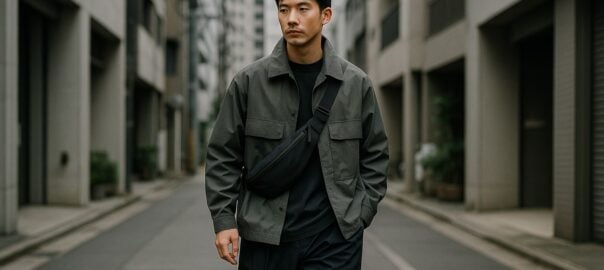
At its base, this look is built around a monochrome or tonal palette—blacks, greys, off-whites, olive, navy. You won’t find bright color blocking or graphic overload here. The visual interest comes from layering and fabrication, not from prints or branding.
Fabrics do the talking. Think nylon, mesh, ripstop, and semi-sheer synthetics layered over each other in unexpected ways. Lightweight technical shells sit over flowy knits. Overshirts mix with longline tees. Volume shifts across the outfit, often stacking wide-leg pants with cropped, boxy jackets.
There’s also a subtle emphasis on asymmetry—zippered slants, layered hems, mismatched sleeves. Everything feels engineered but wearable, like the outfit was assembled with intention, not impulse.
To pull off this style, start with technical outerwear. Look for cropped jackets with sharp lines, waterproof textures, and functional detailing—storm flaps, matte zippers, or mesh panels. They add structure and allow for sharp layering moves, especially in transitional weather.
Wide-leg pants or stacked trousers come next. These add volume and movement to the fit. Think drawstring cargos in ripstop nylon or tailored trousers that taper slightly toward the ankle. The goal is shape, not slouch.
Then there’s the sleek crossbody or chest rig—a core element of the Tokyo silhouette. It’s not just for storage. It’s a framing device. It breaks up the upper body, adds depth to flat fabrics, and signals a kind of soft urban armor without feeling aggressive.
Footwear usually stays muted—black runners, minimal hiking hybrids, or low-profile sneakers with sculpted soles. Accessories are sparse but intentional: matte sunglasses, a beanie with no logo, or a simple silver ring.
What’s drawing global eyes to Tokyo’s new street style is how it balances restraint with experimentation. You can wear it head-to-toe or pick it apart for ideas. The color palette makes it accessible. The details make it distinctive.
It’s a style that merges utility with self-expression, prioritizing how things feel and function over how loudly they shout. That’s part of what makes it so appealing right now—especially as more men look to dress with purpose and personality, not just trend alignment.
There’s also a confidence in the quietness. It’s fashion-forward without being performative. The creativity lives in the cut, the fit, and the fabric—not in brand names or hype signals.

Tokyo’s new streetwear scene shows that you don’t need logos or color to stand out. With structure, texture, and fit, you can create a look that feels fresh, expressive, and technically sharp—all without ever raising your voice.
This is the future of understated cool—and it’s already on the ground.

The editorial team at FashionBeans is your trusted partner in redefining modern men’s style. Established in 2007, FashionBeans has evolved into a leading authority in men’s fashion, with millions of readers seeking practical advice, expert insights, and real-world inspiration for curating their wardrobe and lifestyle.
Our editorial team combines over 50 years of collective experience in fashion journalism, styling, and retail. Each editor brings specialized expertise—from luxury fashion and sustainable style to the latest grooming technology and fragrance science. With backgrounds ranging from GQ and Esquire to personal styling for celebrities, our team ensures every recommendation comes from a place of deep industry knowledge.
 08 July 2025
 FashionBeans Editors
We independently evaluate all recommended products and services. Any products or services put forward appear in no particular order. if you click on links we provide, we may receive compensation.
Walk through the backstreets of Harajuku or catch a glimpse of the crowd outside a Tokyo pop-up, and you’ll notice a shift in the city’s signature streetwear. The new wave isn’t loud. It’s not logo-heavy. And it doesn’t lean on vintage references or sneaker drops.
Instead, it’s layered, textural, and quietly complex—a blend of techwear, architectural silhouettes, and muted color theory. Call it minimalist utility. Call it wearable design. Either way, it’s redefining what street style looks like in one of the most trend-forward cities on the planet.
At its base, this look is built around a monochrome or tonal palette—blacks, greys, off-whites, olive, navy. You won’t find bright color blocking or graphic overload here. The visual interest comes from layering and fabrication, not from prints or branding.
Fabrics do the talking. Think nylon, mesh, ripstop, and semi-sheer synthetics layered over each other in unexpected ways. Lightweight technical shells sit over flowy knits. Overshirts mix with longline tees. Volume shifts across the outfit, often stacking wide-leg pants with cropped, boxy jackets.
There’s also a subtle emphasis on asymmetry—zippered slants, layered hems, mismatched sleeves. Everything feels engineered but wearable, like the outfit was assembled with intention, not impulse.
To pull off this style, start with technical outerwear. Look for cropped jackets with sharp lines, waterproof textures, and functional detailing—storm flaps, matte zippers, or mesh panels. They add structure and allow for sharp layering moves, especially in transitional weather.
Wide-leg pants or stacked trousers come next. These add volume and movement to the fit. Think drawstring cargos in ripstop nylon or tailored trousers that taper slightly toward the ankle. The goal is shape, not slouch.
Then there’s the sleek crossbody or chest rig—a core element of the Tokyo silhouette. It’s not just for storage. It’s a framing device. It breaks up the upper body, adds depth to flat fabrics, and signals a kind of soft urban armor without feeling aggressive.
Footwear usually stays muted—black runners, minimal hiking hybrids, or low-profile sneakers with sculpted soles. Accessories are sparse but intentional: matte sunglasses, a beanie with no logo, or a simple silver ring.
What’s drawing global eyes to Tokyo’s new street style is how it balances restraint with experimentation. You can wear it head-to-toe or pick it apart for ideas. The color palette makes it accessible. The details make it distinctive.
It’s a style that merges utility with self-expression, prioritizing how things feel and function over how loudly they shout. That’s part of what makes it so appealing right now—especially as more men look to dress with purpose and personality, not just trend alignment.
There’s also a confidence in the quietness. It’s fashion-forward without being performative. The creativity lives in the cut, the fit, and the fabric—not in brand names or hype signals.
Tokyo’s new streetwear scene shows that you don’t need logos or color to stand out. With structure, texture, and fit, you can create a look that feels fresh, expressive, and technically sharp—all without ever raising your voice.
This is the future of understated cool—and it’s already on the ground.
The editorial team at FashionBeans is your trusted partner in redefining modern men’s style. Established in 2007, FashionBeans has evolved into a leading authority in men’s fashion, with millions of readers seeking practical advice, expert insights, and real-world inspiration for curating their wardrobe and lifestyle.
Our editorial team combines over 50 years of collective experience in fashion journalism, styling, and retail. Each editor brings specialized expertise—from luxury fashion and sustainable style to the latest grooming technology and fragrance science. With backgrounds ranging from GQ and Esquire to personal styling for celebrities, our team ensures every recommendation comes from a place of deep industry knowledge.


Get the latest Men's Style Advice, Evergreen Guides, Shopping Tips, and Exclusive Deals From Today's Top Brands.
We respect your privacy. We won't spam you.
Get the latest Men's Style Advice, Evergreen Guides, Shopping Tips, and Exclusive Deals From Today's Top Brands.
We respect your privacy. We won't spam you.
