
Get On The List
Get the latest Men's Style Advice, Evergreen Guides, Shopping Tips, and Exclusive Deals From Today's Top Brands.

 01 September 2026
 The Iron Snail
We independently evaluate all recommended products and services. Any products or services put forward appear in no particular order. if you click on links we provide, we may receive compensation.

Quince may look like your friendly neighborhood clothing brand, but they are out for blood. Quince’s whole thing is saying, “We offer luxury and insane quality for dramatically less.”
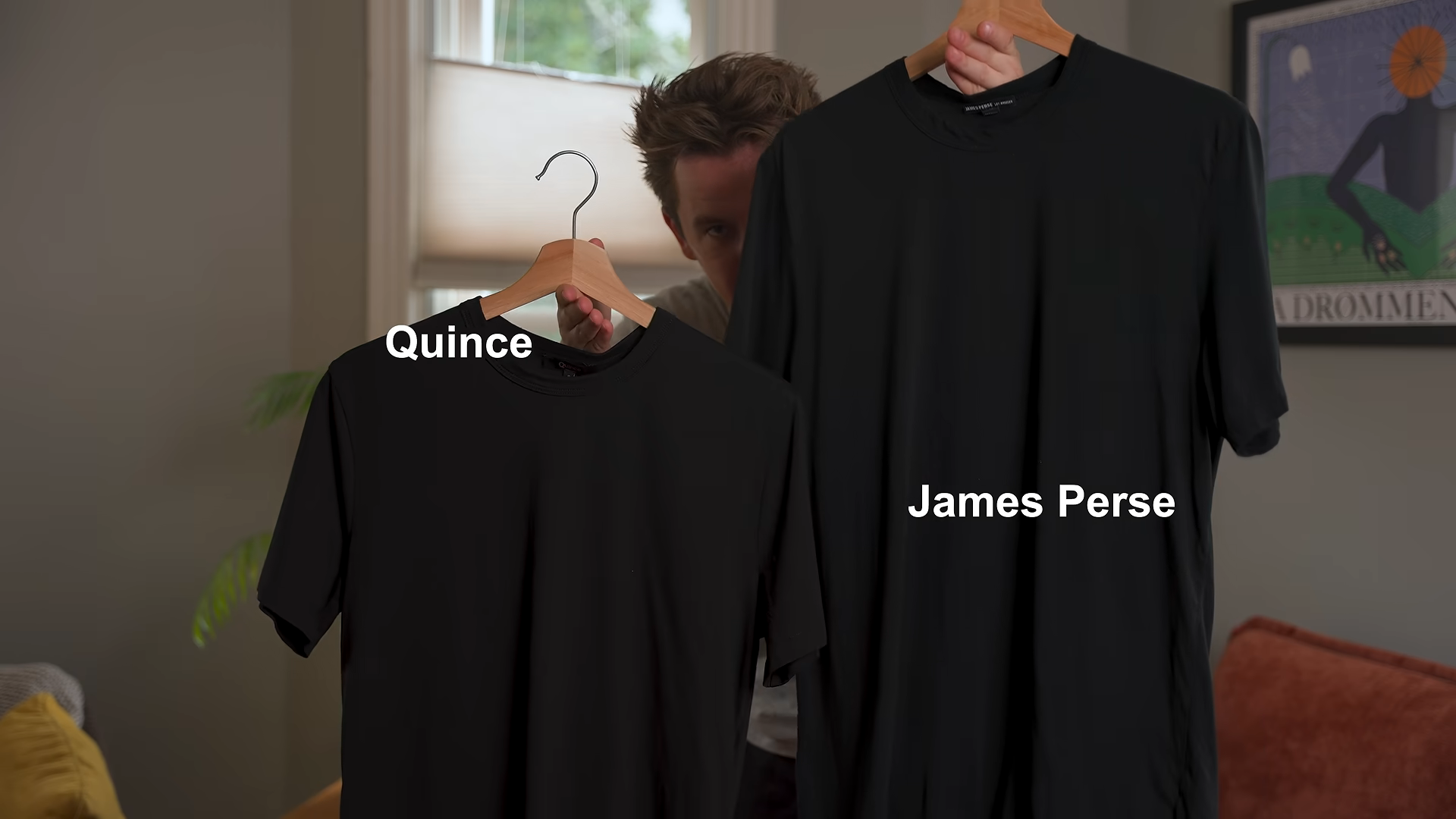
This is a $160 Suvin cotton T-shirt. Suvin cotton is a very nice cotton that is grown in India, very expensive. That cotton is spun into a Japanese Lotus yarn, which is a proprietary name from a Japanese company. Then knit, then sewn all in Japan. $160 from James Perse.
And then we have this shirt from Quince made from Japanese Lotus yarn in Suvin cotton. It retails for $29.90.
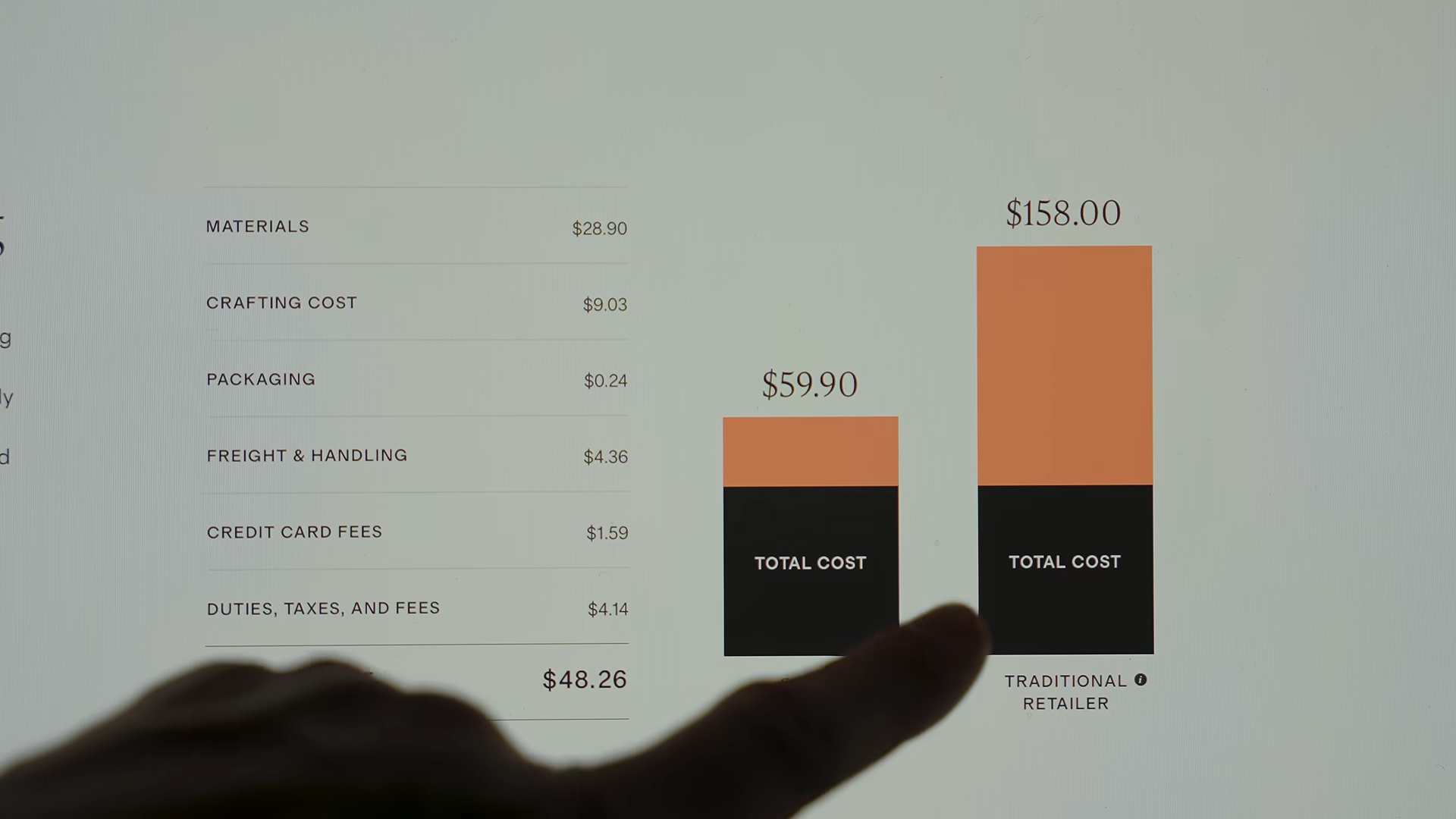
Quince doesn’t say, “Hey, our clothing is better for less.” They openly attack other brands. They put it on their website. They always have this graphic showing you just how much the competition is actually ripping you off.
Quince only needs a little bit of orange. The competition’s whole screen’s got to be orange.
So far, Quince has been sued by Ugg’s parent company, Coach’s parent company, Yeti, and Williams-Sonoma. Probably more that I didn’t write down, but what’s crazy is they want to fight.
The Williams-Sonoma lawsuit says, “When Williams-Sonoma discovered Quince’s false comparisons, they notified Quince with the hope that Quince would correct the errors and compete fairly in the marketplace. Instead, they asserted Williams-Sonoma’s claims were frivolous and challenged them to a legal battle, stating Quince would welcome a public skirmish.”
So, I figured if Quince is going to talk that tough talk, why don’t I just get the Quince version and then the really expensive version that they’re comparing themselves to and see if I can figure out the difference. See if they can try and pull a fast one on old Mikey boy.
No, I did kind of go into this article thinking Quince’s going to do pretty good because in modern days we can make pretty darn good clothing for pretty low prices, but I didn’t think I would get that wrong.
Wow. Wow.

I bought five things from Quince and then their more expensive counterpart. $160 shirt versus $30 shirt. $500 shearling versus $2,600 shearling. Expensive linen versus cheap linen. This wool cruiser jacket versus the wool cruiser jacket and, of course, their $50 monster that started this all, their cashmere sweater.
Every single news outlet on the planet has talked about this $50 cashmere sweater. Quince’s graphic this time around chose Todd Snyder as their opponent. This $320 cashmere sweater.
So, we’re going to go head-to-head because we all know Quince welcomes a public skirmish.
Okay with knit density, but these are very fluffy yarns, so sometimes it’s hard to tell.
I also put my investigation hat on and I tried to figure out, is this actually real? Is there something going on in the background that justifies all of this and makes sense?

Vince.
Quince.
Nope.
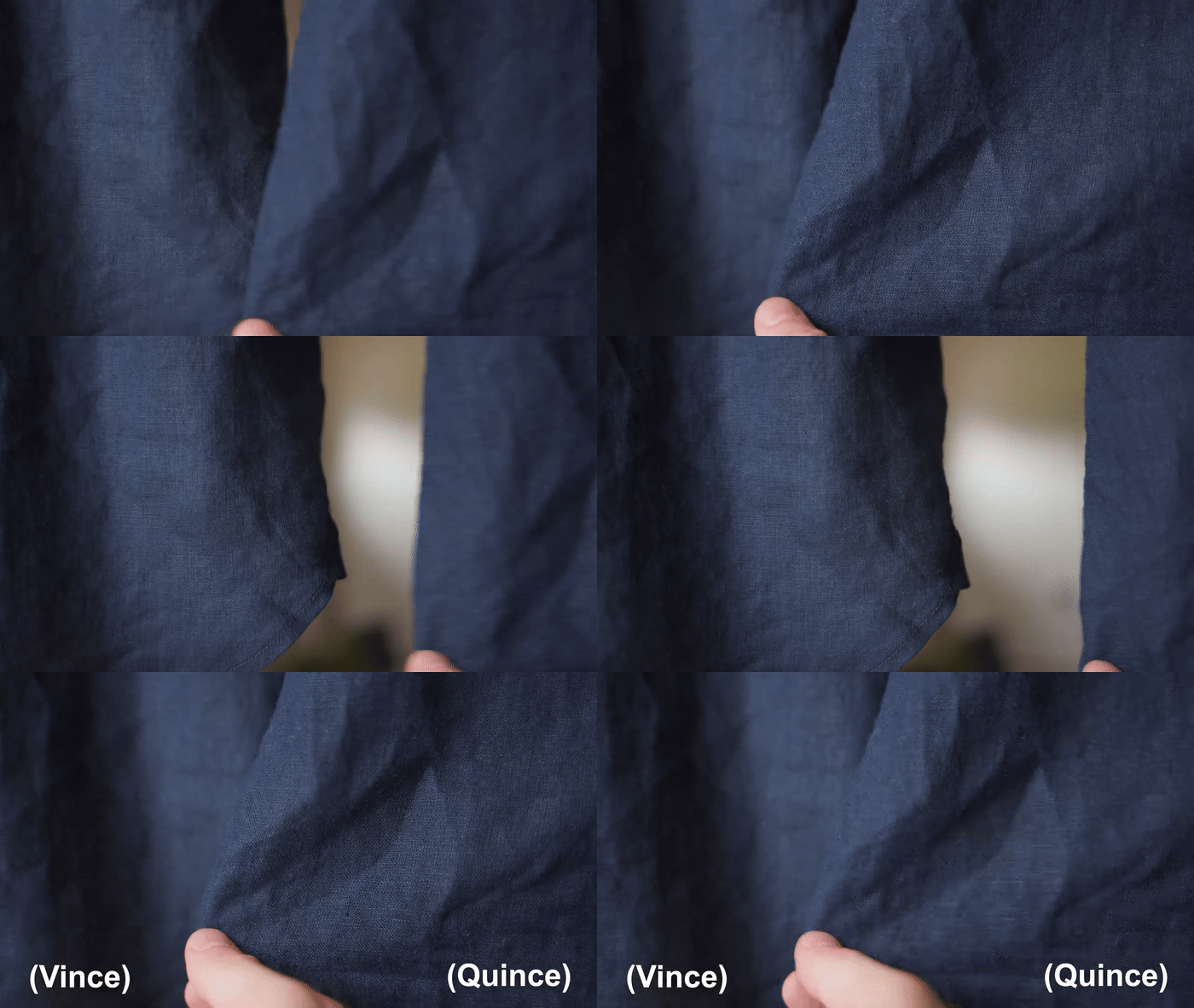
Vince, I’m sorry. Your linen shirt is actually a lot better.
Not going to lie, I was a little nervous filming this part of the article and I got in my head immediately. And Vince versus Quince was the first brand that we tried or second brand that we tried. And the first one screwed me up even more.
So, no. Vince is, it’s, look at this. The linen that Vince is using is super fine, shiny, very smooth. There’s not a lot of slubs or imperfections. It’s very, very nice.
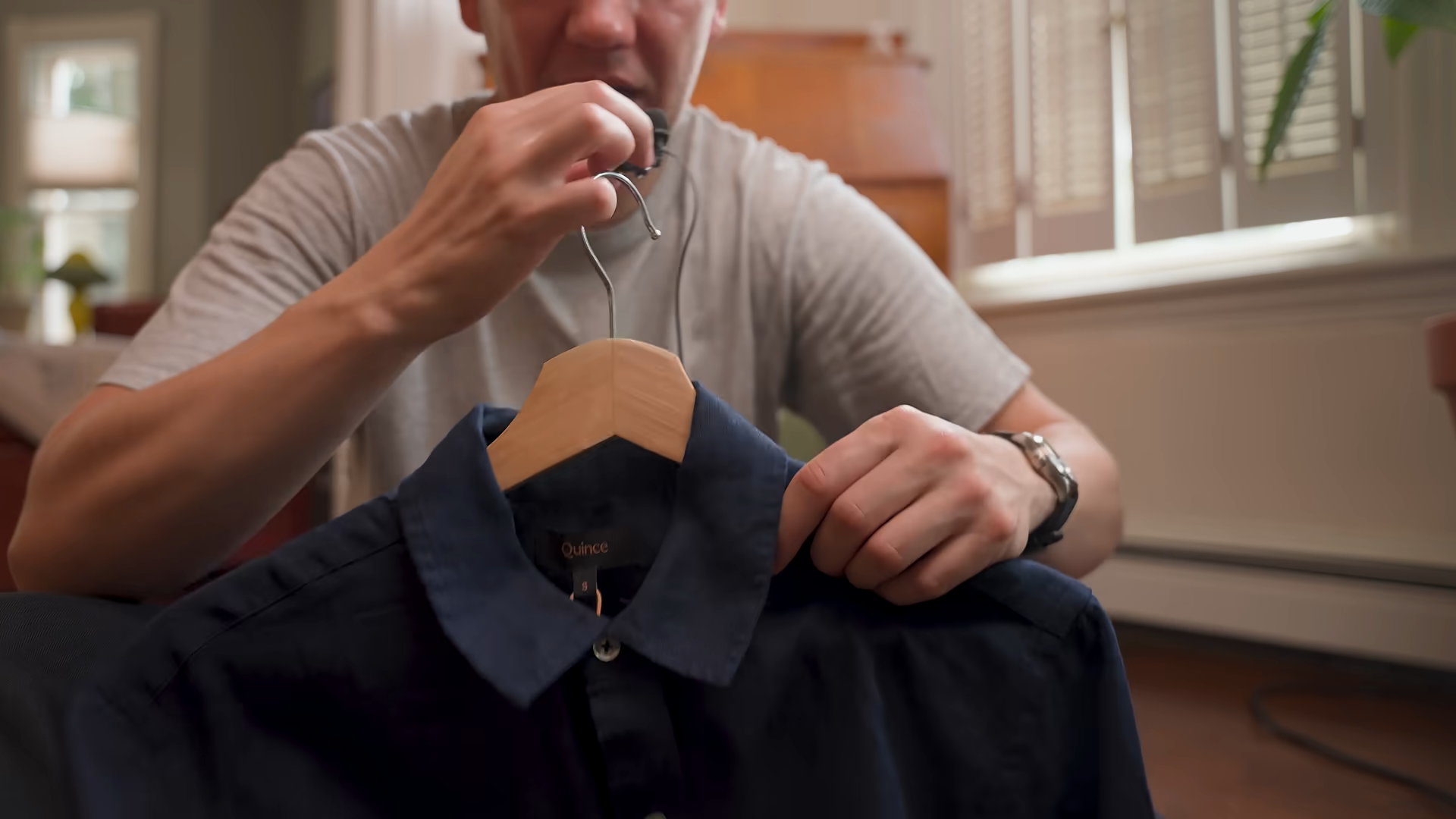
And then Quince’s linen. There’s nothing wrong with it at all. It’s still linen, but they’re using coarser, fatter, less shiny, just not as nice, not as fancy yarns.
I think if you asked 10 people who weren’t in their heads and knowing this was a debate between this fancy thing and not this fancy thing, you just said, “Hey, which linen shirt feels better?” Nine out of 10, maybe even 10 out of 10 people would be like, “Vince.”
Okay.
Anyways, we actually talked about this before, but people in China versus people in the U.S. shop differently. Not always, but a lot of the times the U.S. is very focused on brand. Is this Levi’s T-shirt good, this Gap one, or this Patagonia?
China obviously also has brands and everything like that. Not saying that, but they have a very robust manufacturing and factory system and they do a lot of factory-direct buying.
So there could be an online virtual mall, and instead of comparing two different brands, you’re comparing the exact products. Is this T-shirt and the information about it good versus this one? And which one is cheaper and which one has better reviews?
It’s very blunt.
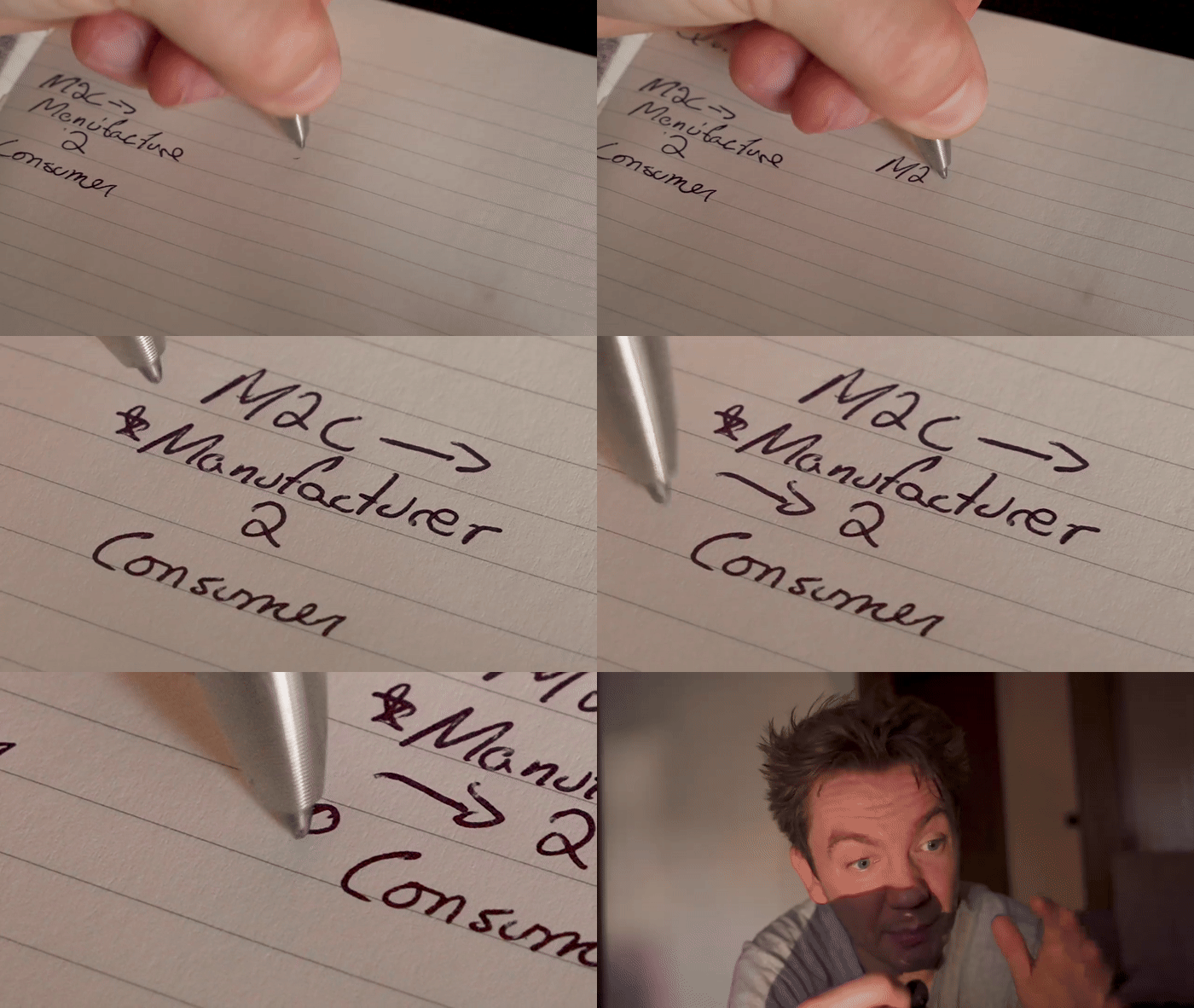
Quince calls that M2C, manufacturer-to-consumer. M-to-C shopping is already in the U.S. It happens quite a bit with brands like SHEIN and Temu that’ll sell you some random crazy thing for a dollar and then ship it directly from overseas.
That’s really starting to explode a lot more. Mainly because the prices are so shocking that people will just try it and buy it and see what comes.
But SHEIN and Temu do not have the greatest reputations in the U.S. People worry about the labor practices. People worry about the quality, if the product is even real. And also, their websites are just absolutely insane.
Look at this. This is Temu. I didn’t type this in. They’re just suggesting that I search for weird stuff that transforms to that.
All of a sudden, you have curation. You have style. You have models. You have reliable products. You know basically what you’re getting, and it’s clean.
But here’s the rub to it all. A lot of brands do do something similar to Quince already. However, their clothing is not as good quality and their prices are not as low.
So, what the heck is Quince actually doing?
Are they good?
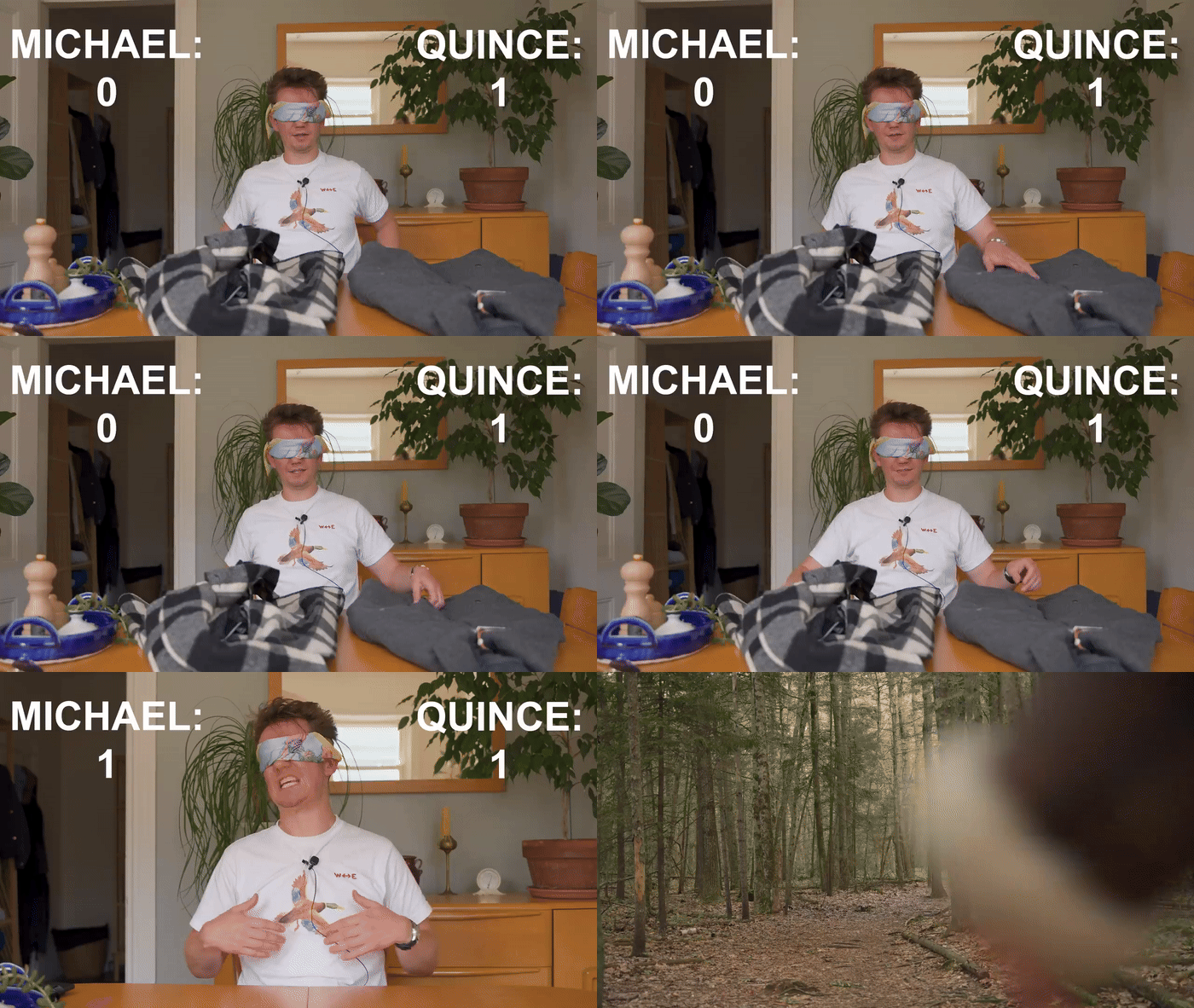
Yep.
Oh, easy. Okay.
Quince. Filson.
Easy. Give me another.
Honestly though, everything else in the Quince package really surprised me.
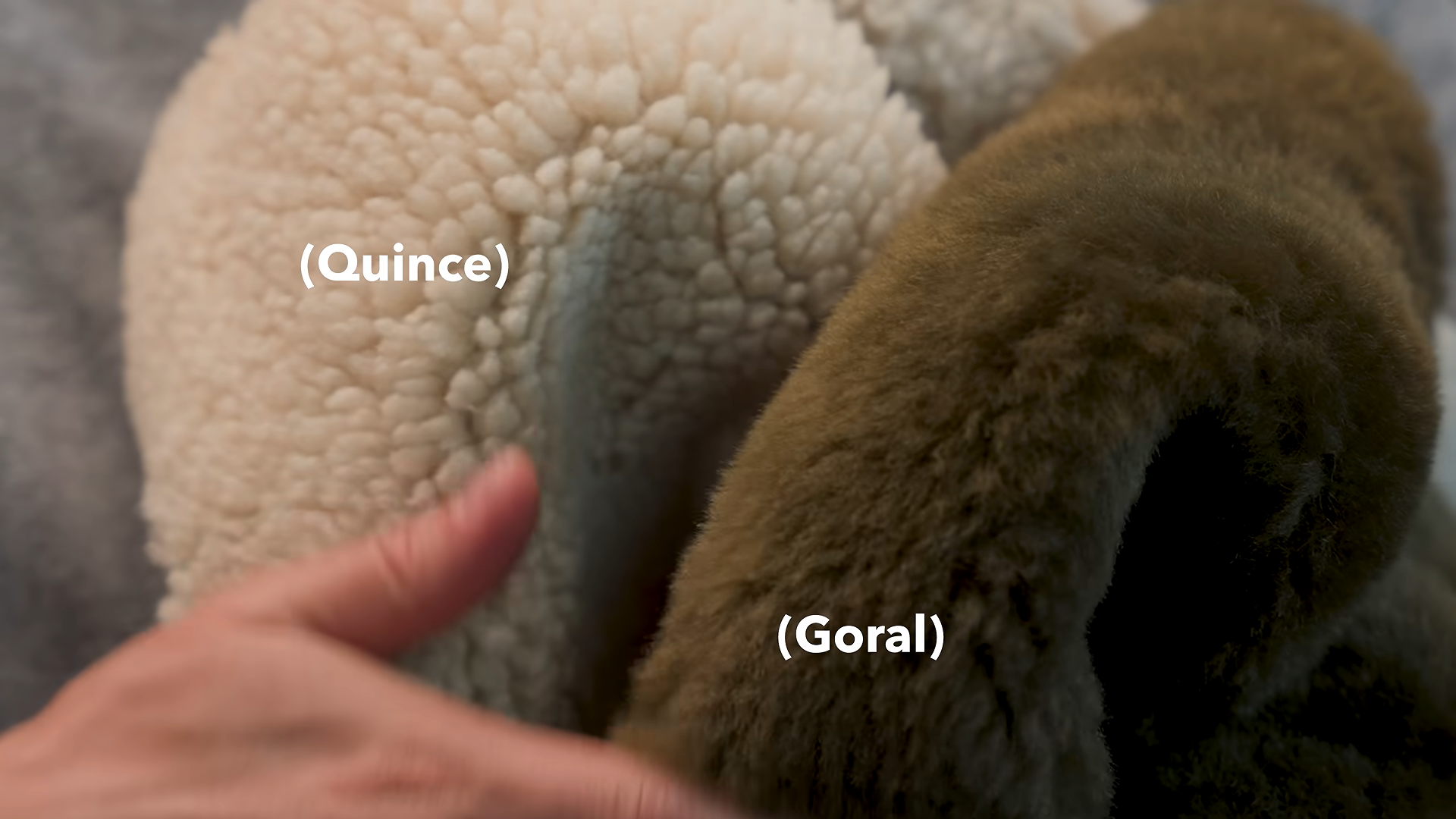
For the most part, this is a $500 Quince shearling jacket compared to Goral’s $2,600 shearling jacket.
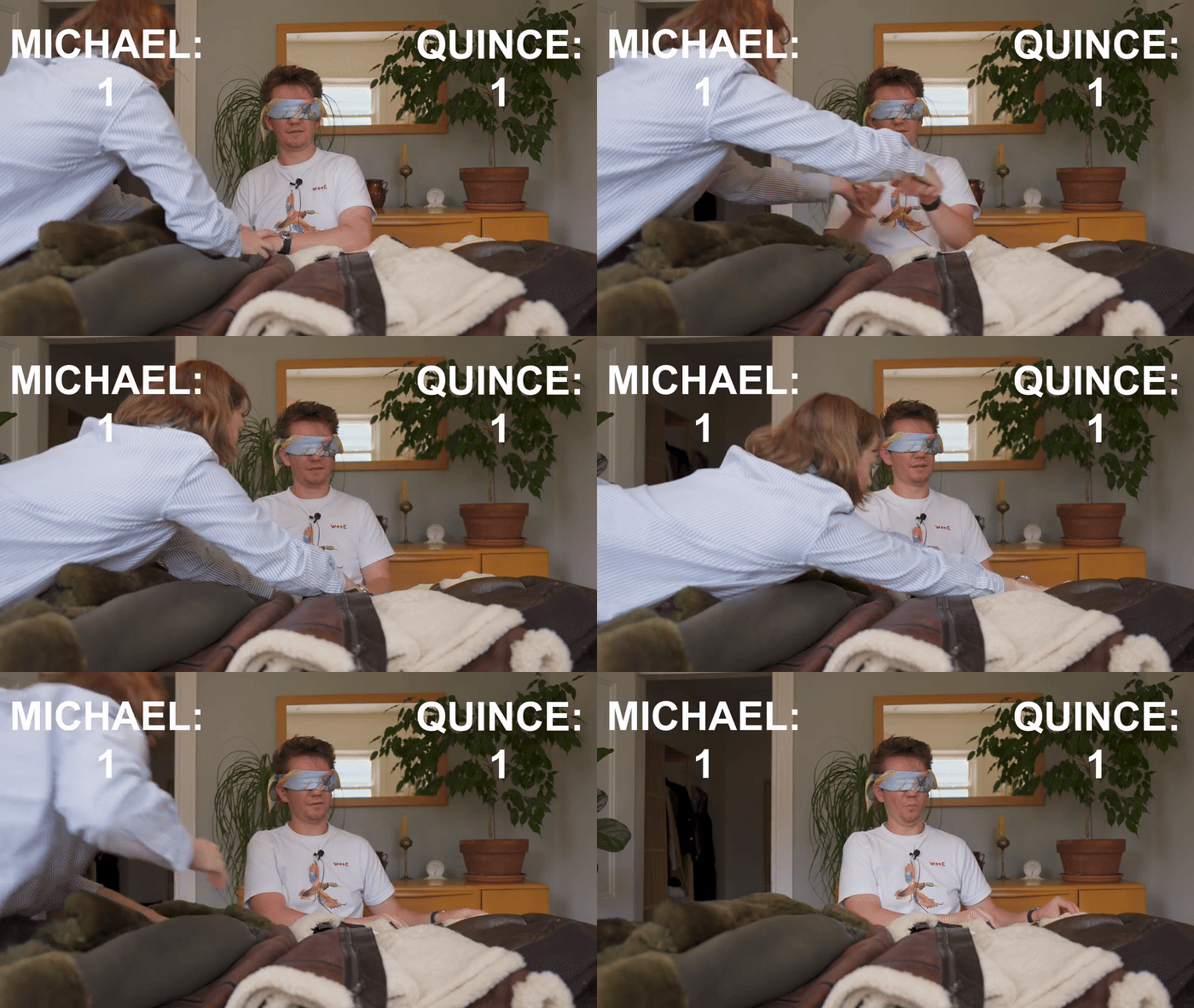
This is one collar. This is one collar. Okay. This is another collar.
Oh, wow.
When Quince says their clothing is better, period, I think everybody’s like, “Well, for the price is what you mean, of course.” But I think Quince means no, it’s virtually better in every single way. Period.
So, my question was, it’s also the middle of summer. Why do they think that and why do they say that?
This section is from a podcast called The Journal on how Quince works under the hood.
Basically, they built a technology that scrapes the web and looks for a variety of things. It looks for what the best sellers are at other companies. Loro Piana, Brunello Cucinelli, Banana Republic, brands like Todd Snyder, a whole bunch of different things, a whole bunch of different categories.
And then they’re looking to see what are the best sellers at those brands. They’re combining all of that. And then they’re saying, “Okay, that is what we’re going to make. We’re going to make copies of that.”
But the kicker is they go a step further and they scrape reviews, of course from the review section of the site, but also on Reddit and stuff all around the internet, and they put that into their product.
Quince’s algorithm may have scraped that the Filson Mackinaw Cruiser is selling well, so they need to make one. But immediately they may have seen on reviews or in discussions that people wish that they didn’t use plastic buttons, so they switched to horn buttons.
Filson’s wool is also known to be just a smidgen rough and also it’s not lined. So what do you do? You use a 90/10 wool-cashmere blend that is quite soft and you add a lining.
And Quince is saying, “Yeah, that is a better jacket. It’s the same form, but it addresses a lot of common customer complaints. So it’s better regardless of price.”
And for a lot of people, honestly, that’s probably true. That a lot of people probably touch a Filson Mackinaw Cruiser and they’re like, “Ooh, that is rough. I would like something softer.”
And that’s why I was struggling so much with all the shearling jackets because I was getting in my head thinking like, okay, what the heck is Quince’s algorithm optimizing for?
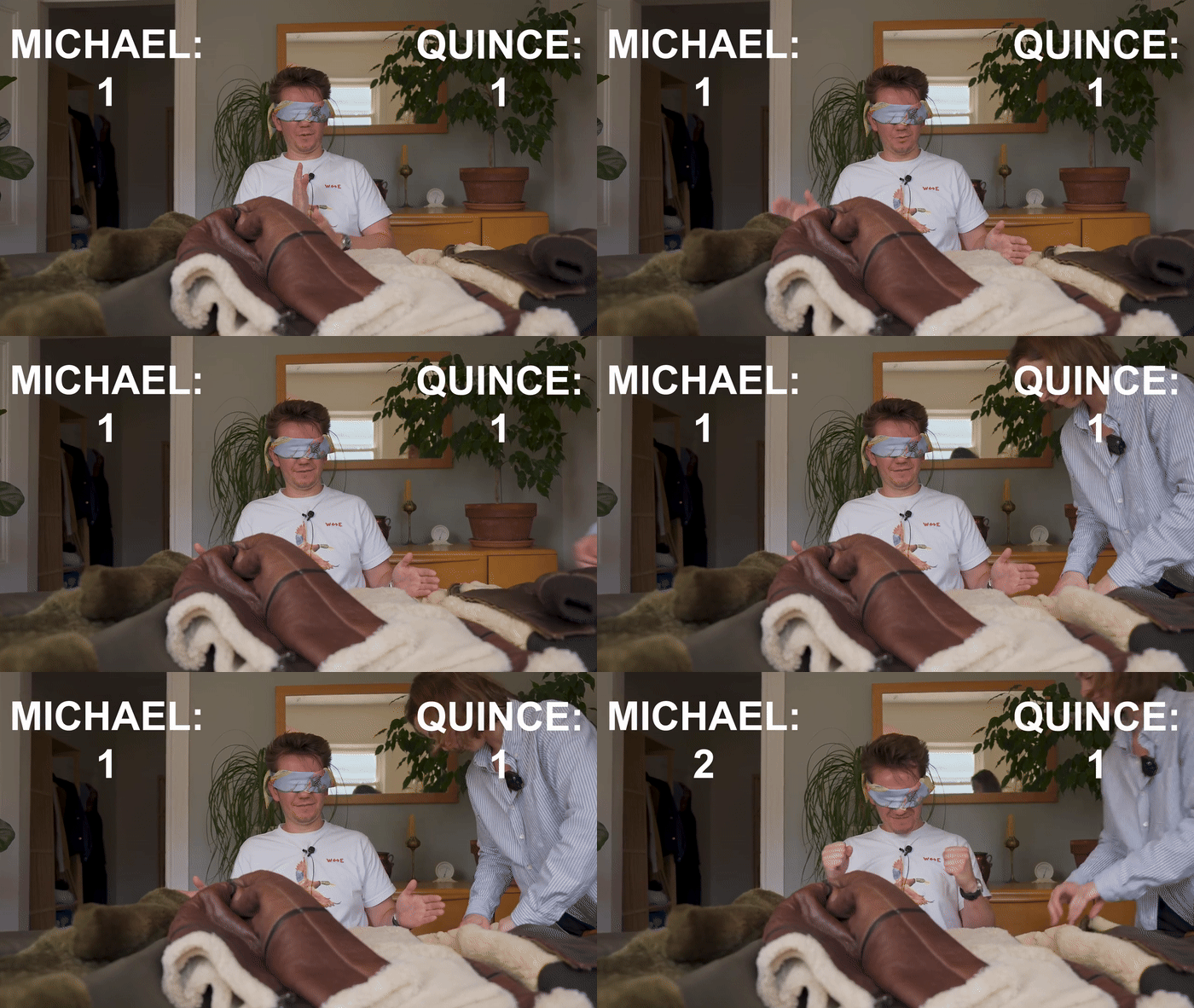
Quince. Vintage Goral.
That’s correct.
Vroom.
It’s just not as nice. It’s not as soft. It’s not as dense. It’s not as plush even at the same pile height. It’s just not the highest quality. That’s the only reason I got it.
This is the first product from Quince when I was actually looking it over and still even right now I’m kind of like, this is too good to be true. This is so nice.
And therein lies the meat of the article. Too good to be true.
And my biggest failure of this entire article.
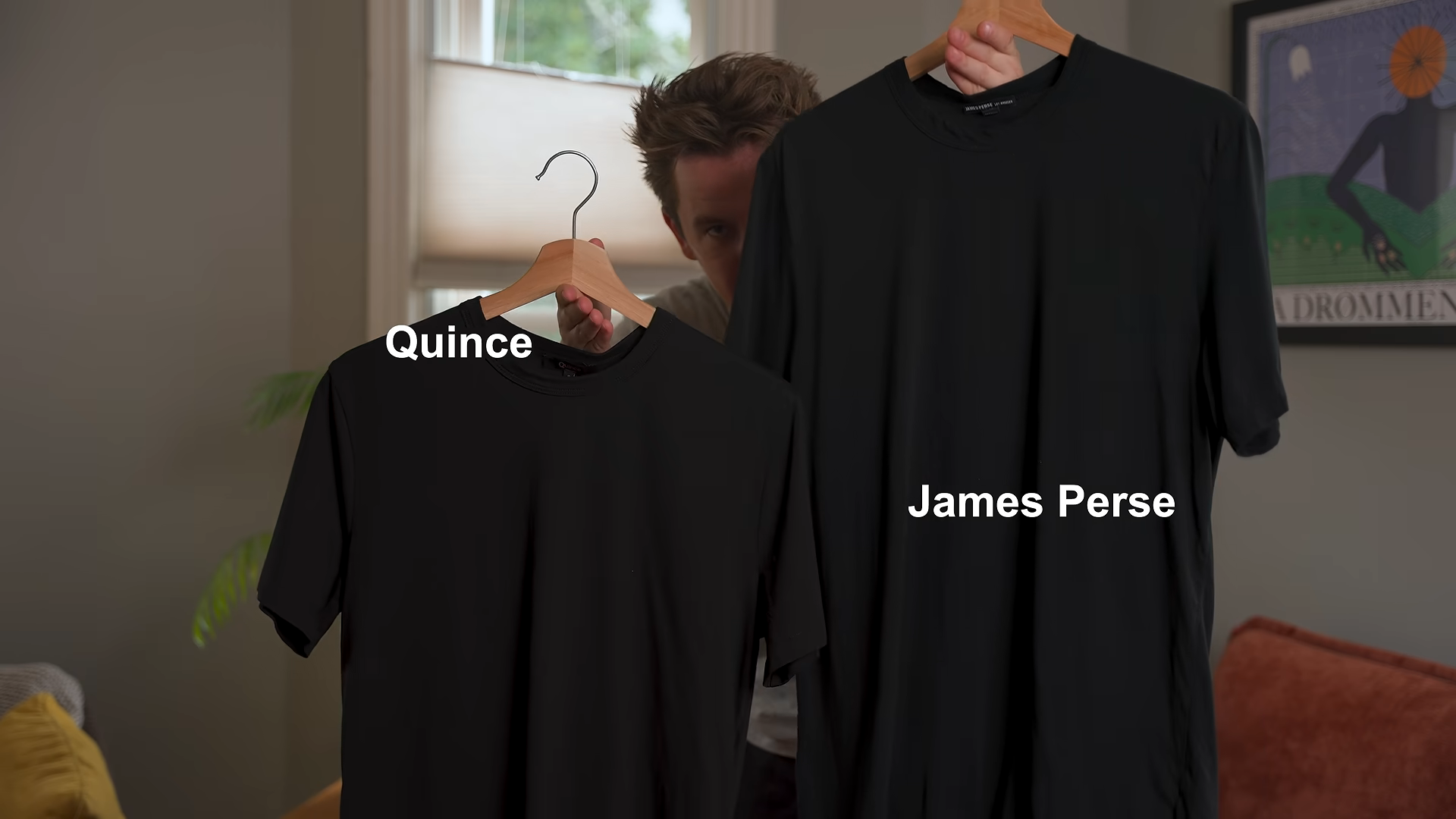
My guess is the James Perse one is going to have better collar construction, but I think the fabric itself is going to be near identical. That’s my guess.
Okie dokie.
So, as I was saying before, Quince’s website basically always has a graphic showing a price breakdown of whatever they’re making. Coincidentally though, not on this shirt, their linen short-sleeve shirt, one of their best sellers.
Please just put a pin in that idea. We’ll come back to it later.
For now, we’re just going to use this long-sleeve shirt on the website as an example. This shirt is much nicer than this shirt, but it’s also much more expensive. And Quince is right. It is kind of crazy to see how that price can happen.
The price of this linen shirt could double just because the brand wants to sell it to retail partners. So, nothing changed. The price had to just go way up.
But what’s even more important is that Quince knows this is not full price. This is a cheap linen shirt. So, the customer probably is not expecting something like that.
Even if Quince is saying it’s going to be like that, we’re like, really? It’s going to be 90% of that maybe, or 80, or 60, but it’s definitely not going to be that.
But they also don’t have to.
And I feel like some people are going to kill me for this, but just hold on. Sometimes I do think Quince delivers near 100% or sometimes even 110%.
Maybe, maybe, maybe, maybe.
That brings us back to this, the suspiciously missing graphic on the linen shirt page.
Where is it?
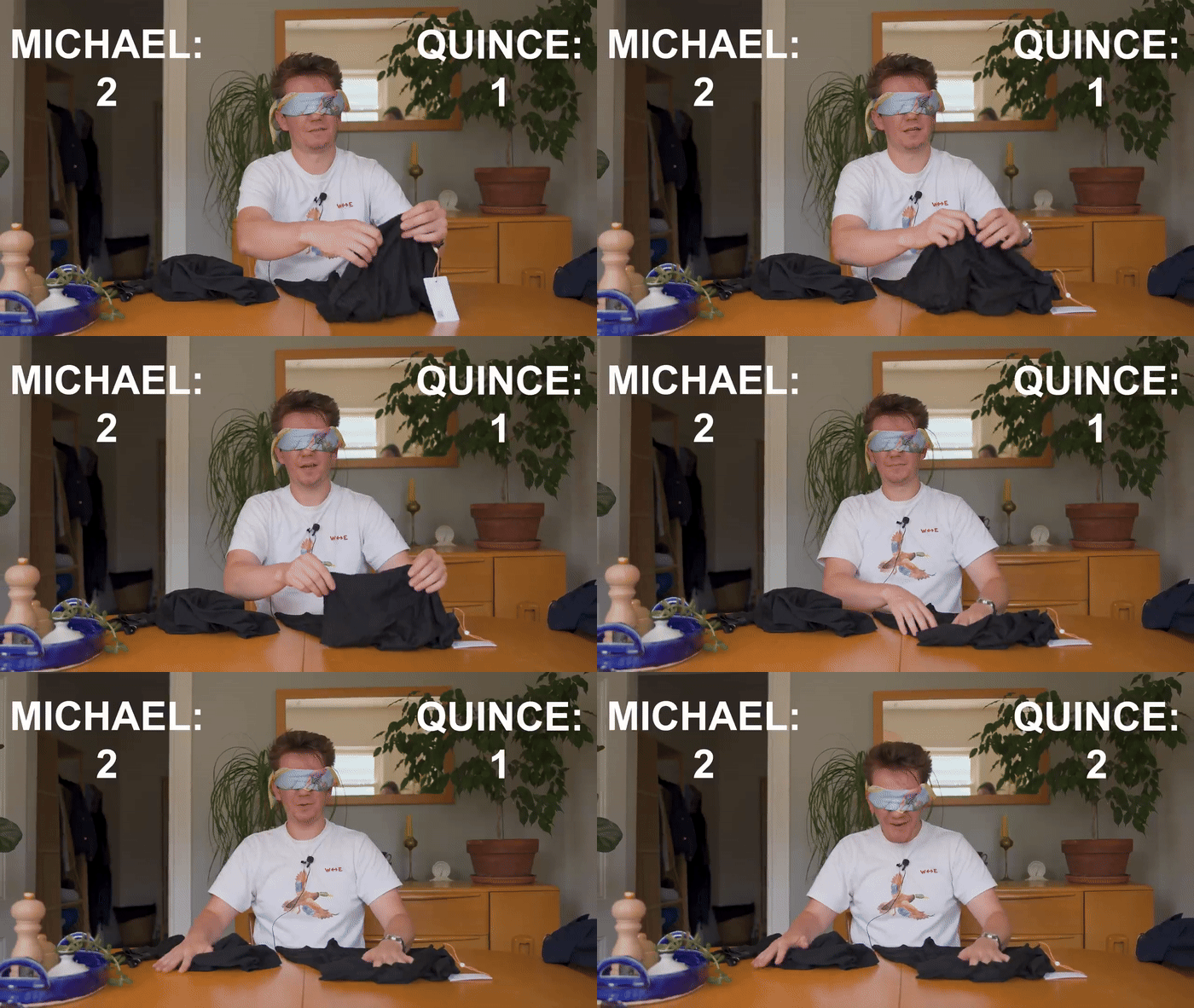
Okay. Okay.
Three, two, one.
James Perse. Quince.
No, really.
Yep.
Wow. Wow.
When I tried to scrape review sites for James Perse, I found this Reddit thread, and they’re saying they love James Perse, but they wish the clothing was more durable.
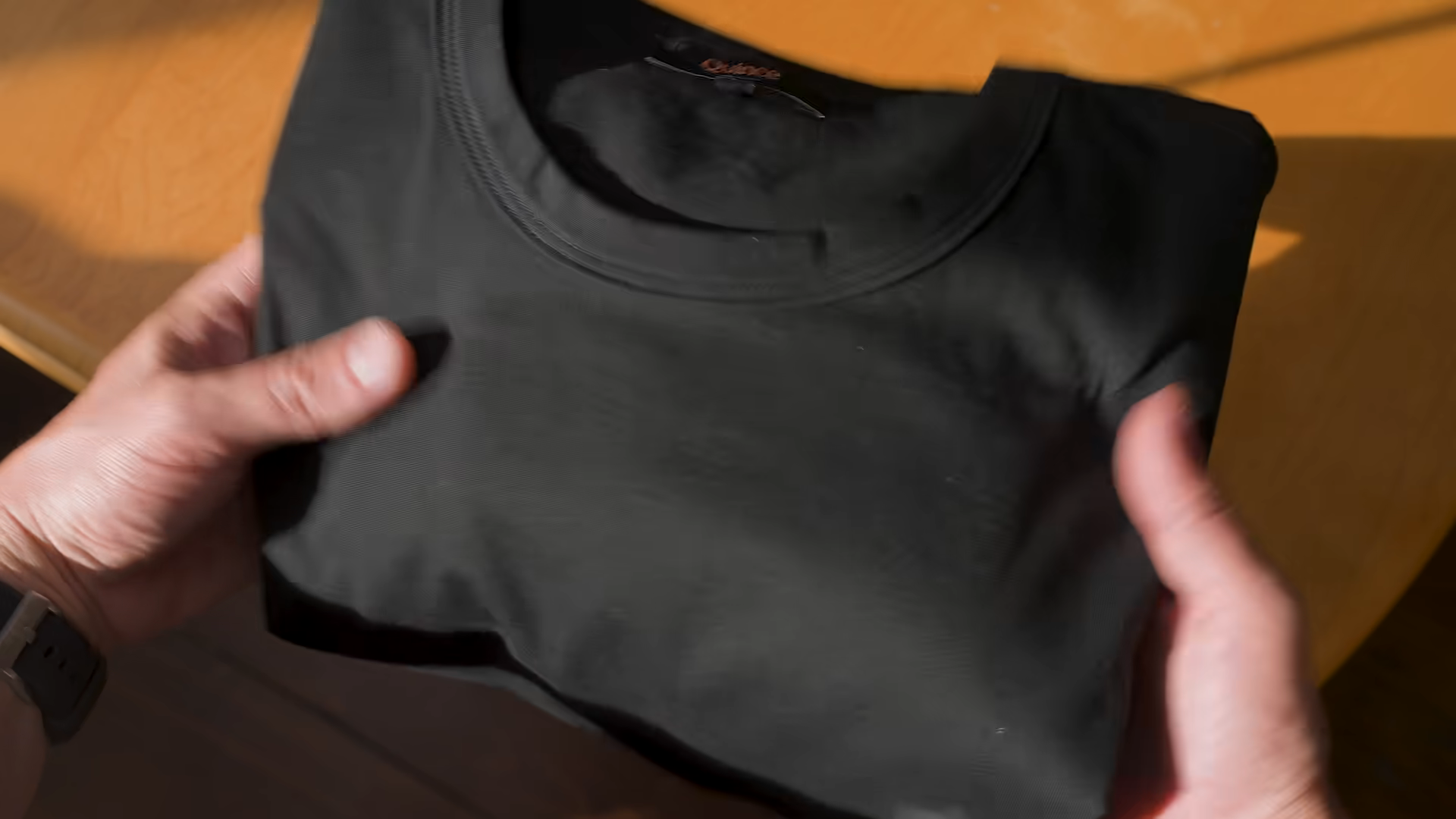
So, if you’re Quince, you might be like, “Okay, make it more durable.” Whatever we can do to improve that. Do it and we’ll offer it for a lower price.
Done.
And those son of a guns got me again.
This time, I have no excuse. I really did think that was James Perse. I had—I wasn’t nervous. I just—it was a lot smoother.
But look, $9.31 of fabric cost per shirt. I kind of would expect Lotus Yarn to be higher, but Quince is maybe ordering a giant order. Maybe it’s not the same configuration. Maybe it’s not even the same vendor. Who knows?
A $7 cut-and-sew price is definitely higher than I would expect for where they’re manufacturing and how many things they’re manufacturing.
But then the rest of the cost is really transportation and duties and taxes. That’s it.
And this is where I had that moment when you’re researching something and you go, I was trying to calculate the margin of every single product that I bought to see, okay, Quince gives you the numbers, how much everything costs. So, what percentage are they actually keeping?
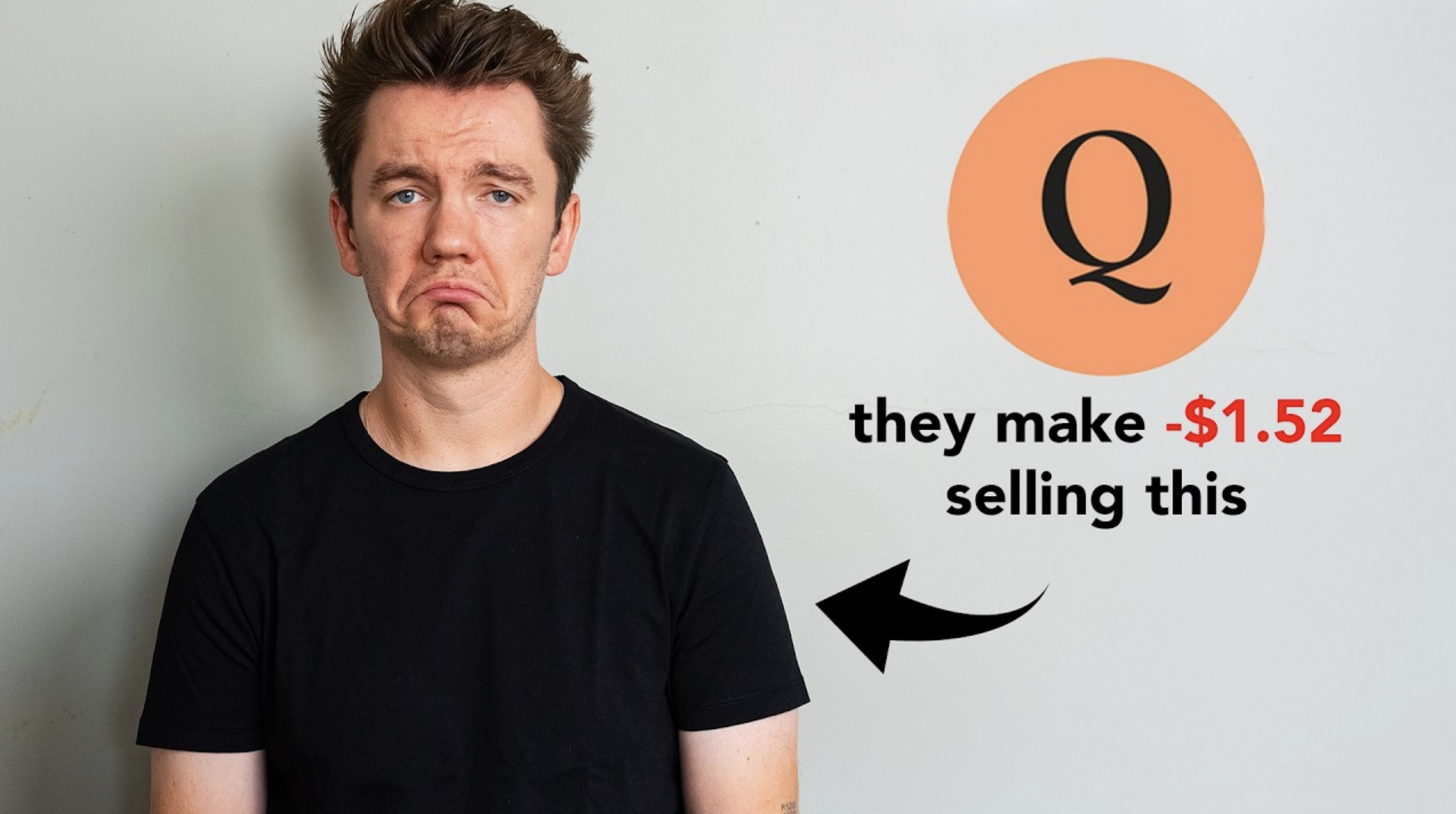
But when I got to the Lotus T-shirt, the percentage they were keeping was -5%. They were losing, minimum, with no returns, just by shipping you this shirt, $1.52 per shirt, which I found very interesting.
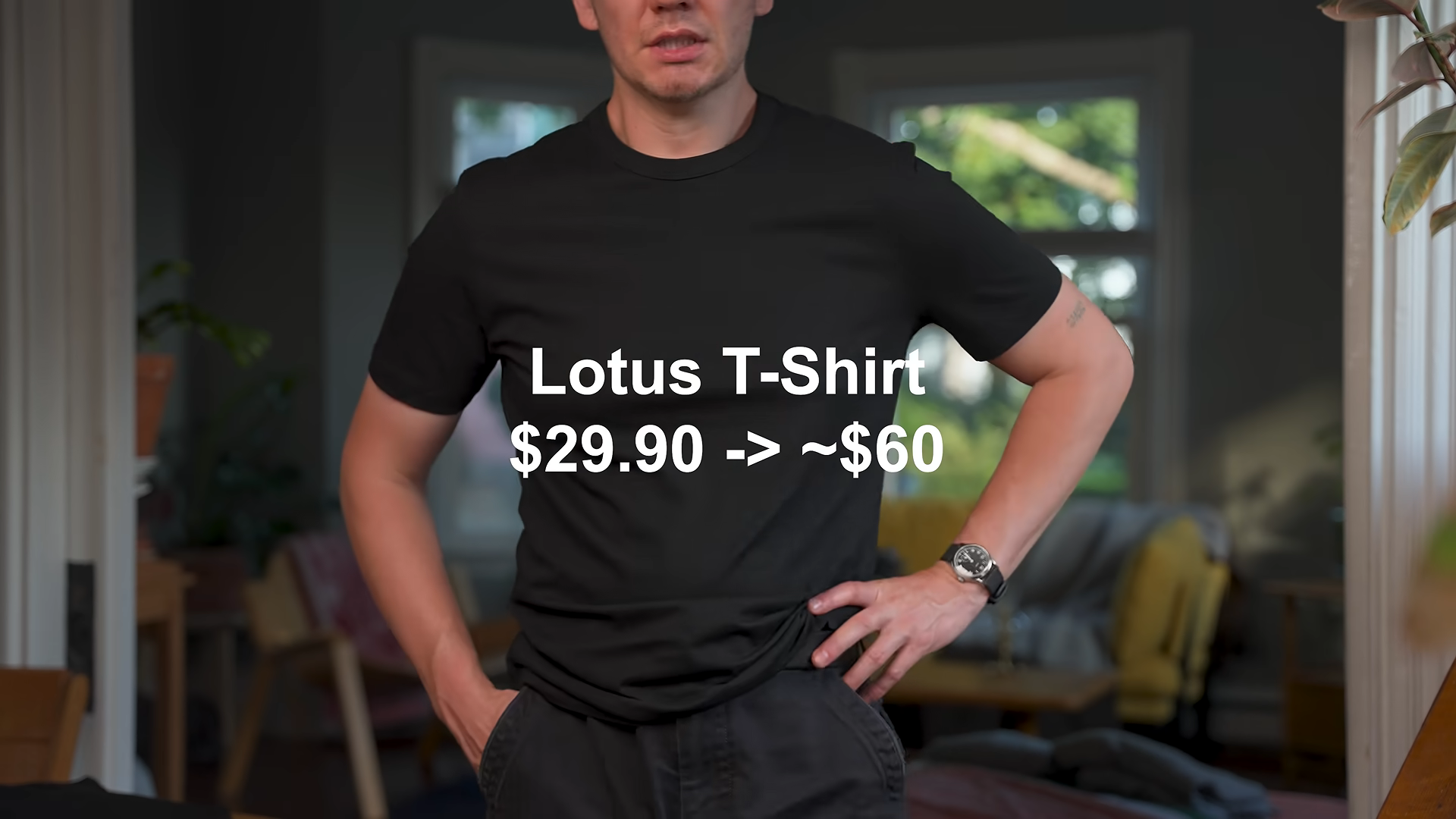
So then I started to try and find more products that were a negative margin, and I did.
Italian pebbled leather slim wristlet. This thing, Quince sold it for $39.90, but it cost them $45.12. They lost like $6 with every wristlet sold.
You and I are probably thinking the same thing. Well, obviously there’s just a mistake on the website. Someone typed in the wrong number.
All of that could be true, but we can agree that it’s at least a little less likely if we’re looking at Quince’s flagship product, a cashmere sweater. They probably double-checked that before they posted it and have looked at it since, and it’s still like that.
So, Quince’s hero flagship marketing products are generally priced at unsustainable margins for a regular business.
Caviar, champagne, cashmere, a Suvin cotton shirt. All stuff that when you get it for a crazy cheap price, you go, “Wow.” Just like I did right there.
Wow.
All right.
Unbelievable.
However, if we did price these products at a conservative business margin, these would be the prices.
I am keeping these prices conservative and lower because Quince is a giant brand. But shearling would be around $690 versus $500. A Lotus, I think, would be between $60 and $70 versus $30.
But what’s really interesting is cashmere, I would say, would be around $100 versus $60. That is exactly how much Uniqlo was selling men’s cashmere for as well.
And their linen, I think, would be around $48 versus $42, which is also near exactly what Uniqlo is selling theirs for as well.
James Perse can’t sell this shirt for a loss or even a really low margin because this shirt is how the company makes money.
Quince, on the other hand, is, of course, they’re selling their shirt, but they’re not selling the shirt.
They’re not like, oh no, we—we didn’t know that.
They are looking at CLV, customer lifetime value.
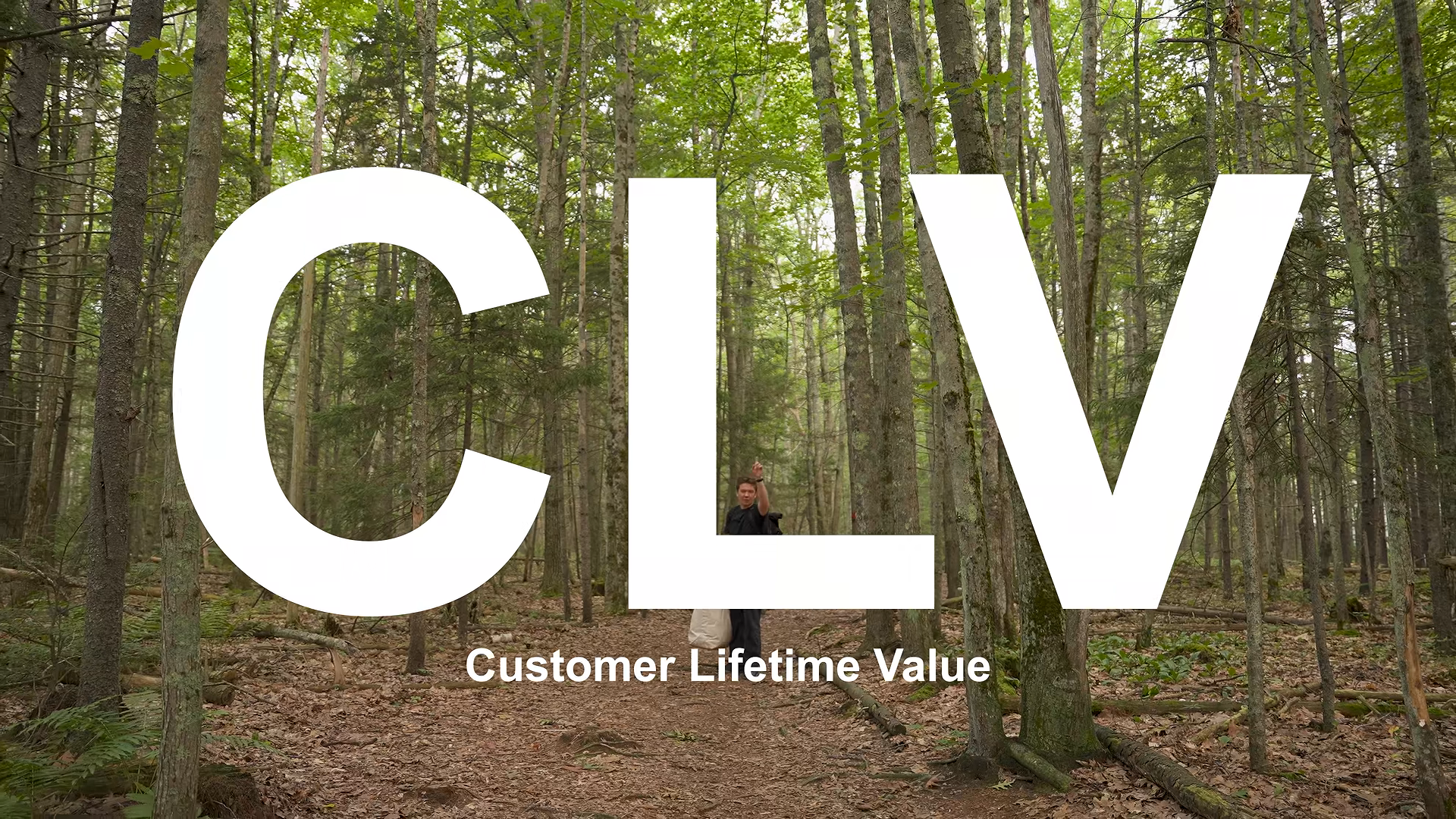
Perfect example that’s been happening to me all summer. I live in Portland, Maine.
And in Portland, Maine and other places in the world, there’s these people with tables and tablecloths over them standing outside. They’re holding an iPad.
When you walk by them, they say, “Hey, do you want to save the puppies?”
My first question is usually, “What puppies? There’s none here.”
So, you say, “Yeah, of course I want to save the puppies.”
They say, “Okay, how much can I put you down for for a monthly subscription?”
I said to the guy, “I give you like 10 bucks. I’ll just do—I don’t want to do a subscription, but I’ll give you a one-time payment of 10 bucks.”
And Taylor was behind me, and she was like, “10? Make it 15.”
And the guy said, “Sorry, I wish that would help, but it’s not going to save the puppies.”
And he just kept repeating it.
Taylor and I were upping the ante. I was like, “Okay, $20.”
And he was like, “I’m sorry, guys. It’s not—I wish that would help. It’s not going to help.”
And we were just like, “Please help us.”
But he was kind of just saying, “Guys, this—the acquisition cost, the reason I’m out here, the agency this puppy place is paying to get donations, I’m going to eat all of that money. You could burn it in front of me. It’s going to do the same thing.
“We need to know, are you going to donate $10 a month for 30 years? Because then you’re actually doing something. Everything else is just getting eaten alive, but over time, you become worth thousands.”
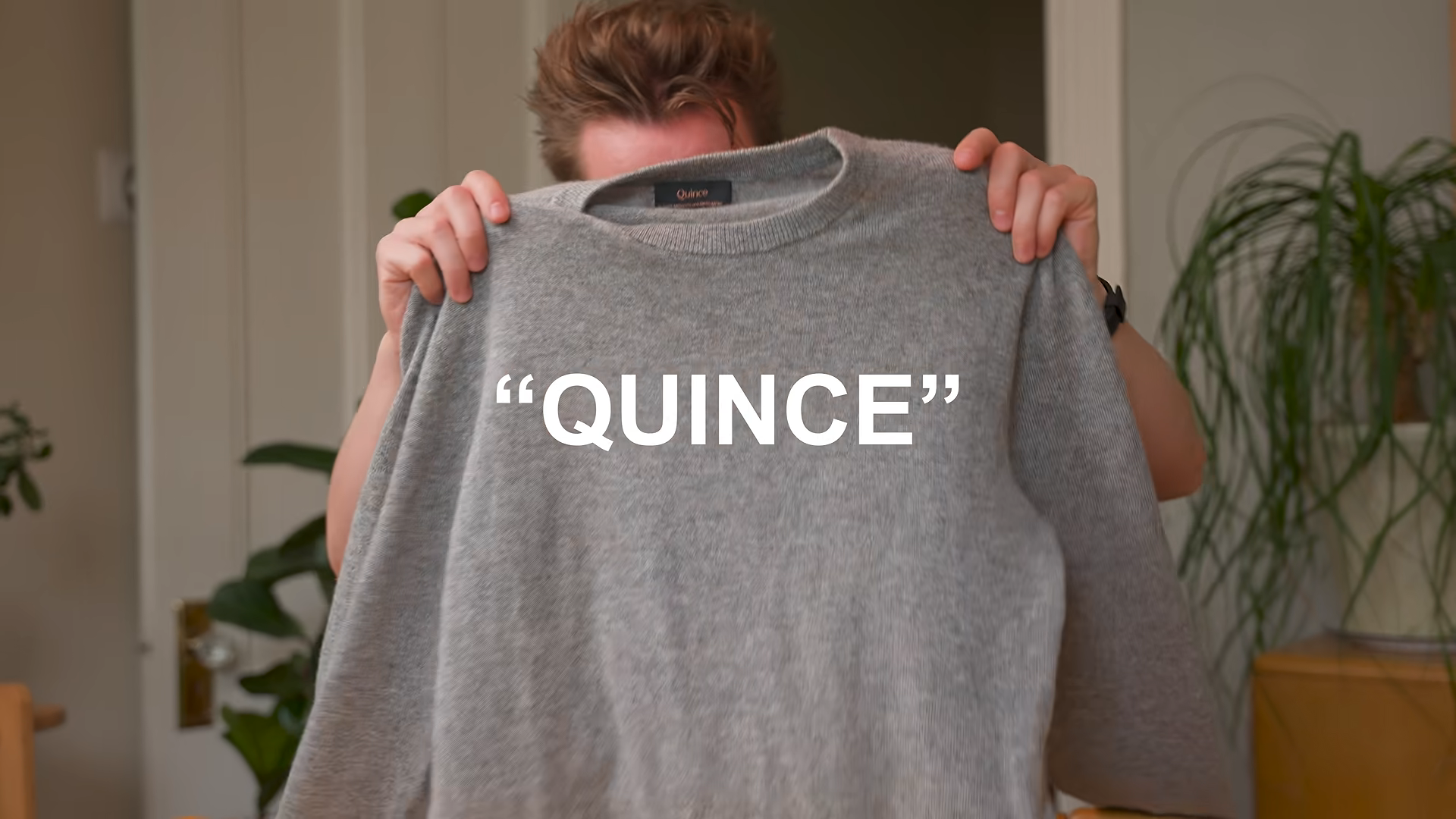
Quince doesn’t need to sell me that shirt to survive at all. What they need is for that shirt to convince me that their luggage, which has a 63% margin, is a clear buy, and I need to buy that.
Quince also recently raised $500 million in investments, and they’re not even saying they’re profitable yet.
But there’s something even more important.
They want to sell their technology and their know-how to other brands because Quince is a technology company before anything else. And if, say, 10 giant brands do want in, all of a sudden Quince may not need to sell anything to keep the lights on.
That’s what I’m saying. That’s why this is so crazy.
Clothing can be subsidized through everything else. It’s not the first time it’s ever happened, but it’s one of the first times it’s ever happened this way.
How does anyone that has an older business model or isn’t doing what Quince does and doesn’t have their software, doesn’t have this, doesn’t have that, how do they compete at all?
The answer, I think, I theorize, is that Quince’s greatest strengths just so happen to also be their greatest weaknesses.
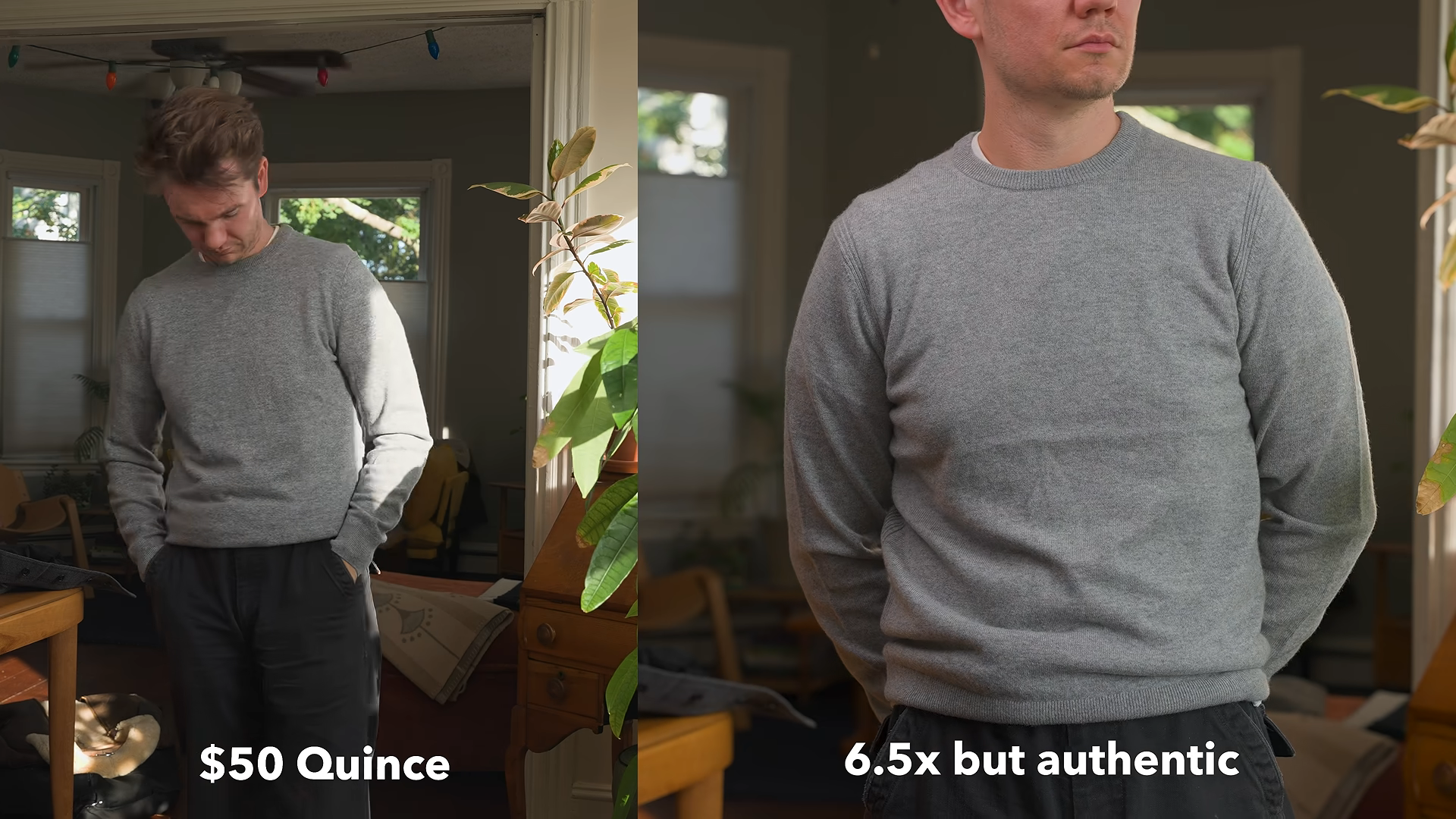
Ooh, this I got to tell you, this feels very similar.
When I was looking at other brands, I was kind of just like, “Wow, what does anyone have to offer against something like this truly?”
And really, there wasn’t a lot of stuff when I was—I was trying to read about it.
And all the big brands that were responding to this were saying authentic. Well, Todd Snyder wasn’t saying it specifically, but they were saying authenticity.
We’re going to be authentic. We’re going to be this. We’re going to be that.
And I was like, does that really matter to people if this is $50? Are a lot of people really going to be like, well, Todd Snyder is more authentic?
But then I realized I am literally the epitome of that customer.
I would see this $50 cashmere sweater and be like, “Okay, well, why is it $50 and who made it? And why did they make it? And what were their ideas behind it?”
And then I’d pick this.
I realized that with Filson. I nailed Filson right away.
The reason I nailed Filson right away is because they make deliberate compromises with their product for what it is.
If you look at that Filson purely through specs and data, of course, you can make the wool softer. But Filson is saying, “Well, we want a rougher wool because it’s tougher.” And this jacket was built for timber cruisers in the forest, so they need that toughness more than anything.
Filson could also easily switch to horn buttons, but again, they’d probably say these last longer, and I’m pretty sure they use the only made-in-America button manufacturer left.
Those are all compromises and rules that go into a Filson Mackinaw Cruiser. And for some people, those rules are non-negotiable.
And that idea brings us to the final example, cashmere.
Cashmere is the wrong tool for the job for most people.
What I would think the general population is after is a very, very soft, lightweight, natural sweater. That’s it.
Cashmere is just kind of shorthand for that in the modern day.
But when you’re a brand like Quince or Naadam or whatever, all these brands selling cashmere, you really want that luxury marketing tag. It’s novel. It’s a giant part of your market.
And all of the fancy brands that are selling things for thousands of dollars are using cashmere.
But if you’re willing to not use cashmere, you can get a way better product out of sheep’s wool, which now you can get almost as soft, if not as soft as cashmere.
It’s stronger, durable, more sustainable, and overall will probably be a way better value than cashmere.
The entire sheep world is trying to make sheep’s wool softer. How fine and strong and whatever can we make it?
And the reverse is happening in cashmere. It is getting coarser because it’s not sustainable to get so much. So you have to get lower-quality cashmere.
Mongolian land is getting destroyed. There’s this professor from Cornell that says there is no sustainable way to make cashmere at the scale we’re making it right now.
And we’re shipping things incredibly inefficiently. Air freight is 10 to 20 times less sustainable than sea freight.
And all of that, I think, is because it’s just so much easier to market the luxury of cashmere than explain why wool might be a better choice.
Quince, because of their model and data scraping, is always going to be pushed to making a unicorn sweater.
It needs to be impossibly soft, impossibly durable, impossibly sustainable, and impossibly cheap. All while also being made only from cashmere.
At the time of making this article, there always has to be some overarching compromise or strong viewpoint a brand has to have in order to make a legendary product that these type of products get compared to.
And Quince’s model and data gathering and stuff makes that very hard to do currently.
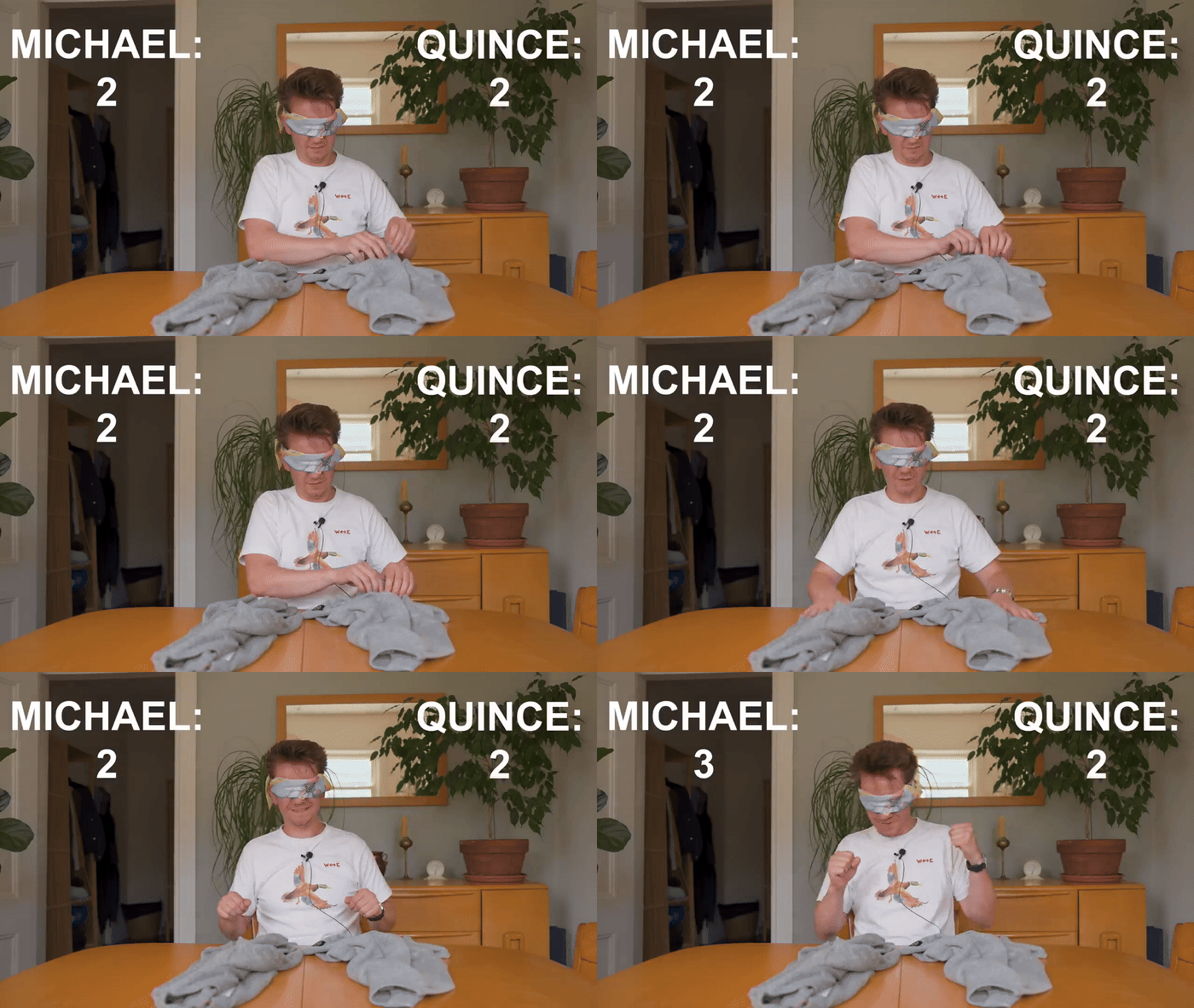
Todd Snyder. Quince.
Yep.
Boom.
Thank goodness that worked out. I was quite nervous I was going to be wrong.
It’s smoother, softer, feels somewhat denser, performs slightly better with pilling all around.
Maybe when you first get the two, like I—I couldn’t notice by hand, but now I can.
This article was adapted from Michael Kristy’s video on The Iron Snail, with edits from FashionBeans, and was reviewed by Michael to ensure the integrity of his original content. Watch the full video here.

The Iron Snail is a men’s fashion vlog (and now article series!) starring a young man named Michael and featuring a snail no bigger than a quarter. The two are set on taking over the world of fashion by creating a clothing line to end all clothing lines. Until then, we’re here to tell you EVERYTHING you need to know about the best clothing out there, from the highest quality raw denim jeans to the warmest jackets to the sturdiest boots…the Iron Snail has got you covered.
 01 September 2026
 Michael Kristy from The Iron Snail
We independently evaluate all recommended products and services. Any products or services put forward appear in no particular order. if you click on links we provide, we may receive compensation.
Quince may look like your friendly neighborhood clothing brand, but they are out for blood. Quince’s whole thing is saying, “We offer luxury and insane quality for dramatically less.”
This is a $160 Suvin cotton T-shirt. Suvin cotton is a very nice cotton that is grown in India, very expensive. That cotton is spun into a Japanese Lotus yarn, which is a proprietary name from a Japanese company. Then knit, then sewn all in Japan. $160 from James Perse.
And then we have this shirt from Quince made from Japanese Lotus yarn in Suvin cotton. It retails for $29.90.
Quince doesn’t say, “Hey, our clothing is better for less.” They openly attack other brands. They put it on their website. They always have this graphic showing you just how much the competition is actually ripping you off.
Quince only needs a little bit of orange. The competition’s whole screen’s got to be orange.
So far, Quince has been sued by Ugg’s parent company, Coach’s parent company, Yeti, and Williams-Sonoma. Probably more that I didn’t write down, but what’s crazy is they want to fight.
The Williams-Sonoma lawsuit says, “When Williams-Sonoma discovered Quince’s false comparisons, they notified Quince with the hope that Quince would correct the errors and compete fairly in the marketplace. Instead, they asserted Williams-Sonoma’s claims were frivolous and challenged them to a legal battle, stating Quince would welcome a public skirmish.”
So, I figured if Quince is going to talk that tough talk, why don’t I just get the Quince version and then the really expensive version that they’re comparing themselves to and see if I can figure out the difference. See if they can try and pull a fast one on old Mikey boy.
No, I did kind of go into this article thinking Quince’s going to do pretty good because in modern days we can make pretty darn good clothing for pretty low prices, but I didn’t think I would get that wrong.
Wow. Wow.
I bought five things from Quince and then their more expensive counterpart. $160 shirt versus $30 shirt. $500 shearling versus $2,600 shearling. Expensive linen versus cheap linen. This wool cruiser jacket versus the wool cruiser jacket and, of course, their $50 monster that started this all, their cashmere sweater.
Every single news outlet on the planet has talked about this $50 cashmere sweater. Quince’s graphic this time around chose Todd Snyder as their opponent. This $320 cashmere sweater.
So, we’re going to go head-to-head because we all know Quince welcomes a public skirmish.
Okay with knit density, but these are very fluffy yarns, so sometimes it’s hard to tell.
I also put my investigation hat on and I tried to figure out, is this actually real? Is there something going on in the background that justifies all of this and makes sense?
Vince.
Quince.
Nope.
Vince, I’m sorry. Your linen shirt is actually a lot better.
Not going to lie, I was a little nervous filming this part of the article and I got in my head immediately. And Vince versus Quince was the first brand that we tried or second brand that we tried. And the first one screwed me up even more.
So, no. Vince is, it’s, look at this. The linen that Vince is using is super fine, shiny, very smooth. There’s not a lot of slubs or imperfections. It’s very, very nice.
And then Quince’s linen. There’s nothing wrong with it at all. It’s still linen, but they’re using coarser, fatter, less shiny, just not as nice, not as fancy yarns.
I think if you asked 10 people who weren’t in their heads and knowing this was a debate between this fancy thing and not this fancy thing, you just said, “Hey, which linen shirt feels better?” Nine out of 10, maybe even 10 out of 10 people would be like, “Vince.”
Okay.
Anyways, we actually talked about this before, but people in China versus people in the U.S. shop differently. Not always, but a lot of the times the U.S. is very focused on brand. Is this Levi’s T-shirt good, this Gap one, or this Patagonia?
China obviously also has brands and everything like that. Not saying that, but they have a very robust manufacturing and factory system and they do a lot of factory-direct buying.
So there could be an online virtual mall, and instead of comparing two different brands, you’re comparing the exact products. Is this T-shirt and the information about it good versus this one? And which one is cheaper and which one has better reviews?
It’s very blunt.
Quince calls that M2C, manufacturer-to-consumer. M-to-C shopping is already in the U.S. It happens quite a bit with brands like SHEIN and Temu that’ll sell you some random crazy thing for a dollar and then ship it directly from overseas.
That’s really starting to explode a lot more. Mainly because the prices are so shocking that people will just try it and buy it and see what comes.
But SHEIN and Temu do not have the greatest reputations in the U.S. People worry about the labor practices. People worry about the quality, if the product is even real. And also, their websites are just absolutely insane.
Look at this. This is Temu. I didn’t type this in. They’re just suggesting that I search for weird stuff that transforms to that.
All of a sudden, you have curation. You have style. You have models. You have reliable products. You know basically what you’re getting, and it’s clean.
But here’s the rub to it all. A lot of brands do do something similar to Quince already. However, their clothing is not as good quality and their prices are not as low.
So, what the heck is Quince actually doing?
Are they good?
Yep.
Oh, easy. Okay.
Quince. Filson.
Easy. Give me another.
Honestly though, everything else in the Quince package really surprised me.
For the most part, this is a $500 Quince shearling jacket compared to Goral’s $2,600 shearling jacket.
This is one collar. This is one collar. Okay. This is another collar.
Oh, wow.
When Quince says their clothing is better, period, I think everybody’s like, “Well, for the price is what you mean, of course.” But I think Quince means no, it’s virtually better in every single way. Period.
So, my question was, it’s also the middle of summer. Why do they think that and why do they say that?
This section is from a podcast called The Journal on how Quince works under the hood.
Basically, they built a technology that scrapes the web and looks for a variety of things. It looks for what the best sellers are at other companies. Loro Piana, Brunello Cucinelli, Banana Republic, brands like Todd Snyder, a whole bunch of different things, a whole bunch of different categories.
And then they’re looking to see what are the best sellers at those brands. They’re combining all of that. And then they’re saying, “Okay, that is what we’re going to make. We’re going to make copies of that.”
But the kicker is they go a step further and they scrape reviews, of course from the review section of the site, but also on Reddit and stuff all around the internet, and they put that into their product.
Quince’s algorithm may have scraped that the Filson Mackinaw Cruiser is selling well, so they need to make one. But immediately they may have seen on reviews or in discussions that people wish that they didn’t use plastic buttons, so they switched to horn buttons.
Filson’s wool is also known to be just a smidgen rough and also it’s not lined. So what do you do? You use a 90/10 wool-cashmere blend that is quite soft and you add a lining.
And Quince is saying, “Yeah, that is a better jacket. It’s the same form, but it addresses a lot of common customer complaints. So it’s better regardless of price.”
And for a lot of people, honestly, that’s probably true. That a lot of people probably touch a Filson Mackinaw Cruiser and they’re like, “Ooh, that is rough. I would like something softer.”
And that’s why I was struggling so much with all the shearling jackets because I was getting in my head thinking like, okay, what the heck is Quince’s algorithm optimizing for?
Quince. Vintage Goral.
That’s correct.
Vroom.
It’s just not as nice. It’s not as soft. It’s not as dense. It’s not as plush even at the same pile height. It’s just not the highest quality. That’s the only reason I got it.
This is the first product from Quince when I was actually looking it over and still even right now I’m kind of like, this is too good to be true. This is so nice.
And therein lies the meat of the article. Too good to be true.
And my biggest failure of this entire article.
My guess is the James Perse one is going to have better collar construction, but I think the fabric itself is going to be near identical. That’s my guess.
Okie dokie.
So, as I was saying before, Quince’s website basically always has a graphic showing a price breakdown of whatever they’re making. Coincidentally though, not on this shirt, their linen short-sleeve shirt, one of their best sellers.
Please just put a pin in that idea. We’ll come back to it later.
For now, we’re just going to use this long-sleeve shirt on the website as an example. This shirt is much nicer than this shirt, but it’s also much more expensive. And Quince is right. It is kind of crazy to see how that price can happen.
The price of this linen shirt could double just because the brand wants to sell it to retail partners. So, nothing changed. The price had to just go way up.
But what’s even more important is that Quince knows this is not full price. This is a cheap linen shirt. So, the customer probably is not expecting something like that.
Even if Quince is saying it’s going to be like that, we’re like, really? It’s going to be 90% of that maybe, or 80, or 60, but it’s definitely not going to be that.
But they also don’t have to.
And I feel like some people are going to kill me for this, but just hold on. Sometimes I do think Quince delivers near 100% or sometimes even 110%.
Maybe, maybe, maybe, maybe.
That brings us back to this, the suspiciously missing graphic on the linen shirt page.
Where is it?
Okay. Okay.
Three, two, one.
James Perse. Quince.
No, really.
Yep.
Wow. Wow.
When I tried to scrape review sites for James Perse, I found this Reddit thread, and they’re saying they love James Perse, but they wish the clothing was more durable.
So, if you’re Quince, you might be like, “Okay, make it more durable.” Whatever we can do to improve that. Do it and we’ll offer it for a lower price.
Done.
And those son of a guns got me again.
This time, I have no excuse. I really did think that was James Perse. I had—I wasn’t nervous. I just—it was a lot smoother.
But look, $9.31 of fabric cost per shirt. I kind of would expect Lotus Yarn to be higher, but Quince is maybe ordering a giant order. Maybe it’s not the same configuration. Maybe it’s not even the same vendor. Who knows?
A $7 cut-and-sew price is definitely higher than I would expect for where they’re manufacturing and how many things they’re manufacturing.
But then the rest of the cost is really transportation and duties and taxes. That’s it.
And this is where I had that moment when you’re researching something and you go, I was trying to calculate the margin of every single product that I bought to see, okay, Quince gives you the numbers, how much everything costs. So, what percentage are they actually keeping?
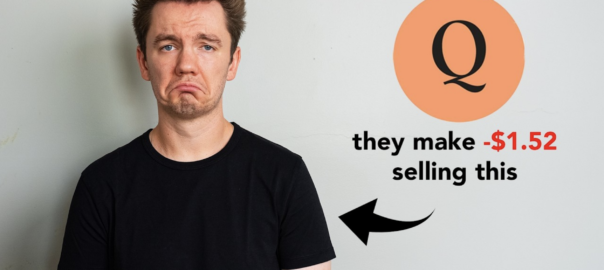
But when I got to the Lotus T-shirt, the percentage they were keeping was -5%. They were losing, minimum, with no returns, just by shipping you this shirt, $1.52 per shirt, which I found very interesting.
So then I started to try and find more products that were a negative margin, and I did.
Italian pebbled leather slim wristlet. This thing, Quince sold it for $39.90, but it cost them $45.12. They lost like $6 with every wristlet sold.
You and I are probably thinking the same thing. Well, obviously there’s just a mistake on the website. Someone typed in the wrong number.
All of that could be true, but we can agree that it’s at least a little less likely if we’re looking at Quince’s flagship product, a cashmere sweater. They probably double-checked that before they posted it and have looked at it since, and it’s still like that.
So, Quince’s hero flagship marketing products are generally priced at unsustainable margins for a regular business.
Caviar, champagne, cashmere, a Suvin cotton shirt. All stuff that when you get it for a crazy cheap price, you go, “Wow.” Just like I did right there.
Wow.
All right.
Unbelievable.
However, if we did price these products at a conservative business margin, these would be the prices.
I am keeping these prices conservative and lower because Quince is a giant brand. But shearling would be around $690 versus $500. A Lotus, I think, would be between $60 and $70 versus $30.
But what’s really interesting is cashmere, I would say, would be around $100 versus $60. That is exactly how much Uniqlo was selling men’s cashmere for as well.
And their linen, I think, would be around $48 versus $42, which is also near exactly what Uniqlo is selling theirs for as well.
James Perse can’t sell this shirt for a loss or even a really low margin because this shirt is how the company makes money.
Quince, on the other hand, is, of course, they’re selling their shirt, but they’re not selling the shirt.
They’re not like, oh no, we—we didn’t know that.
They are looking at CLV, customer lifetime value.
Perfect example that’s been happening to me all summer. I live in Portland, Maine.
And in Portland, Maine and other places in the world, there’s these people with tables and tablecloths over them standing outside. They’re holding an iPad.
When you walk by them, they say, “Hey, do you want to save the puppies?”
My first question is usually, “What puppies? There’s none here.”
So, you say, “Yeah, of course I want to save the puppies.”
They say, “Okay, how much can I put you down for for a monthly subscription?”
I said to the guy, “I give you like 10 bucks. I’ll just do—I don’t want to do a subscription, but I’ll give you a one-time payment of 10 bucks.”
And Taylor was behind me, and she was like, “10? Make it 15.”
And the guy said, “Sorry, I wish that would help, but it’s not going to save the puppies.”
And he just kept repeating it.
Taylor and I were upping the ante. I was like, “Okay, $20.”
And he was like, “I’m sorry, guys. It’s not—I wish that would help. It’s not going to help.”
And we were just like, “Please help us.”
But he was kind of just saying, “Guys, this—the acquisition cost, the reason I’m out here, the agency this puppy place is paying to get donations, I’m going to eat all of that money. You could burn it in front of me. It’s going to do the same thing.
“We need to know, are you going to donate $10 a month for 30 years? Because then you’re actually doing something. Everything else is just getting eaten alive, but over time, you become worth thousands.”
Quince doesn’t need to sell me that shirt to survive at all. What they need is for that shirt to convince me that their luggage, which has a 63% margin, is a clear buy, and I need to buy that.
Quince also recently raised $500 million in investments, and they’re not even saying they’re profitable yet.
But there’s something even more important.
They want to sell their technology and their know-how to other brands because Quince is a technology company before anything else. And if, say, 10 giant brands do want in, all of a sudden Quince may not need to sell anything to keep the lights on.
That’s what I’m saying. That’s why this is so crazy.
Clothing can be subsidized through everything else. It’s not the first time it’s ever happened, but it’s one of the first times it’s ever happened this way.
How does anyone that has an older business model or isn’t doing what Quince does and doesn’t have their software, doesn’t have this, doesn’t have that, how do they compete at all?
The answer, I think, I theorize, is that Quince’s greatest strengths just so happen to also be their greatest weaknesses.
Ooh, this I got to tell you, this feels very similar.
When I was looking at other brands, I was kind of just like, “Wow, what does anyone have to offer against something like this truly?”
And really, there wasn’t a lot of stuff when I was—I was trying to read about it.
And all the big brands that were responding to this were saying authentic. Well, Todd Snyder wasn’t saying it specifically, but they were saying authenticity.
We’re going to be authentic. We’re going to be this. We’re going to be that.
And I was like, does that really matter to people if this is $50? Are a lot of people really going to be like, well, Todd Snyder is more authentic?
But then I realized I am literally the epitome of that customer.
I would see this $50 cashmere sweater and be like, “Okay, well, why is it $50 and who made it? And why did they make it? And what were their ideas behind it?”
And then I’d pick this.
I realized that with Filson. I nailed Filson right away.
The reason I nailed Filson right away is because they make deliberate compromises with their product for what it is.
If you look at that Filson purely through specs and data, of course, you can make the wool softer. But Filson is saying, “Well, we want a rougher wool because it’s tougher.” And this jacket was built for timber cruisers in the forest, so they need that toughness more than anything.
Filson could also easily switch to horn buttons, but again, they’d probably say these last longer, and I’m pretty sure they use the only made-in-America button manufacturer left.
Those are all compromises and rules that go into a Filson Mackinaw Cruiser. And for some people, those rules are non-negotiable.
And that idea brings us to the final example, cashmere.
Cashmere is the wrong tool for the job for most people.
What I would think the general population is after is a very, very soft, lightweight, natural sweater. That’s it.
Cashmere is just kind of shorthand for that in the modern day.
But when you’re a brand like Quince or Naadam or whatever, all these brands selling cashmere, you really want that luxury marketing tag. It’s novel. It’s a giant part of your market.
And all of the fancy brands that are selling things for thousands of dollars are using cashmere.
But if you’re willing to not use cashmere, you can get a way better product out of sheep’s wool, which now you can get almost as soft, if not as soft as cashmere.
It’s stronger, durable, more sustainable, and overall will probably be a way better value than cashmere.
The entire sheep world is trying to make sheep’s wool softer. How fine and strong and whatever can we make it?
And the reverse is happening in cashmere. It is getting coarser because it’s not sustainable to get so much. So you have to get lower-quality cashmere.
Mongolian land is getting destroyed. There’s this professor from Cornell that says there is no sustainable way to make cashmere at the scale we’re making it right now.
And we’re shipping things incredibly inefficiently. Air freight is 10 to 20 times less sustainable than sea freight.
And all of that, I think, is because it’s just so much easier to market the luxury of cashmere than explain why wool might be a better choice.
Quince, because of their model and data scraping, is always going to be pushed to making a unicorn sweater.
It needs to be impossibly soft, impossibly durable, impossibly sustainable, and impossibly cheap. All while also being made only from cashmere.
At the time of making this article, there always has to be some overarching compromise or strong viewpoint a brand has to have in order to make a legendary product that these type of products get compared to.
And Quince’s model and data gathering and stuff makes that very hard to do currently.
Todd Snyder. Quince.
Yep.
Boom.
Thank goodness that worked out. I was quite nervous I was going to be wrong.
It’s smoother, softer, feels somewhat denser, performs slightly better with pilling all around.
Maybe when you first get the two, like I—I couldn’t notice by hand, but now I can.
This article was adapted from Michael Kristy’s video on The Iron Snail, with edits from FashionBeans, and was reviewed by Michael to ensure the integrity of his original content. Watch the full video here.
The Iron Snail is a men’s fashion vlog (and now article series!) starring a young man named Michael and featuring a snail no bigger than a quarter. The two are set on taking over the world of fashion by creating a clothing line to end all clothing lines. Until then, we’re here to tell you EVERYTHING you need to know about the best clothing out there, from the highest quality raw denim jeans to the warmest jackets to the sturdiest boots…the Iron Snail has got you covered.


Get the latest Men's Style Advice, Evergreen Guides, Shopping Tips, and Exclusive Deals From Today's Top Brands.
We respect your privacy. We won't spam you.
