


Get On The List
Get the latest Men's Style Advice, Evergreen Guides, Shopping Tips, and Exclusive Deals From Today's Top Brands.

 02 March 2026
 Cillian O'Connor
We independently evaluate all recommended products and services. Any products or services put forward appear in no particular order. if you click on links we provide, we may receive compensation.
Like your clothes, haircuts aren’t one-size-fits-all. But unlike your clothes, you can’t take a crap haircut off after a day of fielding abuse from your colleagues. Before going under the barber’s scissors, consider your face shape alongside your hair texture, growth pattern and the time you want to spend styling. After all, an extra inch here or a smattering of facial hair there can make all the difference.
Whether you’re looking for haircuts for round faces, long or rectangular faces, square faces, heart-shaped faces, diamond-shaped faces, or triangle-shaped faces, we’ve got you covered. And no, you can’t have one of each face. Unless you’re a Batman villain.
If you’re asking yourself, “Which hairstyle suits me?” consider your face shape alongside your texture, growth pattern and styling routine. Use the illustrated face-shape helper in the finder above, or compare the descriptions in the FAQ below. If you are unsure or between shapes, the finder works without choosing one.

Once you have a sense of your face shape, explore the other styling tips below and discuss the options you like with your barber.
| Face Shape Articles |
|---|
| Triangle Face Shapes |
| Rectangle Face Shapes |
| Pear Face Shapes |
| Diamond Face Shapes |
| Oblong Face Shapes |
| Heart-Shaped Faces |
| Square Face Shapes |
| Round Face Shapes |
| Oval Face Shapes |
Use the suggestions below as styling options, not rules about which features need correcting. The quoted experts offer their own preferences; they have not reviewed the interactive finder. Hair texture, density, head shape, growth patterns and your routine can change which version of a cut is practical.
A round face usually has a softer jaw and similar overall length and width. If you want more definition, discuss a cut with some height and a more compact outline at the sides. Keeping a softer, rounded look is also a valid choice.
“If you’ve got a round face shape, think square,” says Stevens. “Since round faces have little in the way of natural angles, you need to create the illusion of structure with your hair. A style with height on the top that’s taken tight at the sides such as a pompadour or a flat top works well to add structure, as do front fringes.”
“Square corners in the high recession area of your hair will sharpen up any soft edges,” adds Robinson. “A full square beard will also help thin the chin area, giving the appearance of a more chiseled jaw.”
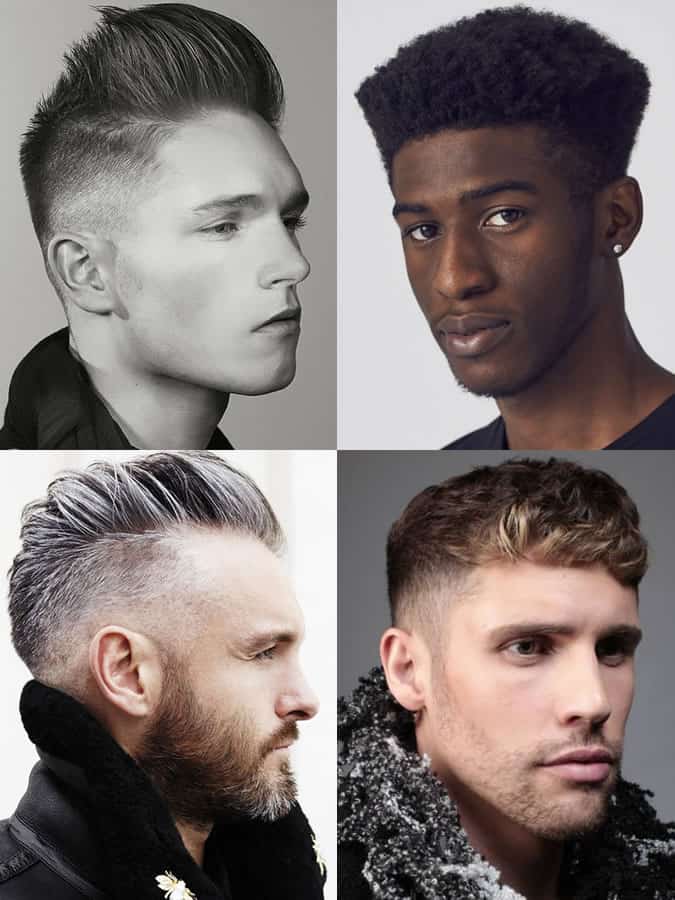
Long faces are noticeably longer than they are wide; the jaw may be rounded or angular. If you want less emphasis on that length, consider a hairstyle with moderate top height and some fullness at the sides.
“Because a rectangular face looks longer, it’s important to avoid taking the sides too short if keeping length on the top, as this would only accentuate the length of the face,” explains Nicolaou. “Try a well-proportioned style that doesn’t take the sides too short or leave too much length on top.”
Hair falling toward the sides or across the forehead can change the visible outline. The same principle applies to facial hair: if you want less visual length, consider a shorter beard, says Robinson. “A full beard only elongates the face, so instead try facial hair that ranges in length from stubble to a short beard to fill out any gaps.”
The outline matters as well as beard length: extra length below the chin can add visual length, while fullness at the sides creates a different effect.

An oval face is generally longer than it is wide, with a softer jaw. It leaves room to experiment with men’s haircuts. Your texture, hairline and preferred finish still matter when choosing a cut.
For a more open forehead and added definition, consider this approach: “The trick with an oval face shape is to wear your hair off the forehead to create some volume and angles on top,” says Aveda master barber Stelios Nicolaou. “The most suitable style is a classic short back and sides and slightly longer on the top, with a side-swept parting.”
A forward fringe changes how much forehead is visible; choose that effect deliberately rather than treating fringes as off-limits. “Too much heaviness on the forehead softens features and increases roundness of the face,” says celebrity hairstylist Jamie Stevens. And feel free to ditch the beard, says Ruffians creative director Denis Robinson. “You don’t need facial hair to fill out any disproportionate gaps in this case, so feel free to go clean-shaven.” https://www.fashionbeans.com/article/classic-mens-hairstyle-the-french-crop/

A square face typically has a more angular jaw and broadly similar length and width. You can emphasize those angles or soften the outline, depending on the look you prefer.
Both extremely short and longer hairstyles are options—from buzz cuts to French crops to quiffs. Shorter cuts expose more of your natural outline; longer sections give you more scope to change the silhouette.
“Classic, neat haircuts complement a square shape best—think close fades, side partings and short layers,” says Stevens. Some light stubble also gives the sharpness of your jawline a little welcome texture without blurring its line.

A heart-shaped face is wider toward the forehead and narrower at the chin. If you want a softer transition between them, discuss how the front sections fall and how much width to keep at the temples.
“Avoid cuts that are very tight, as these will accentuate the narrowness of the chin and the width of the forehead,” says Stevens. “A medium-length swept look is the safest bet.” Mid-length and long hairstyles can be arranged into a softer outline without assuming the hair needs thinning. If you’re looking for something modern, a soft mullet could be a way to switch up your regular style.
For readers who want more visual fullness around the chin and jaw, Robinson suggests considering facial hair. “As with the diamond face shape, a beard helps a heart shape gain fullness in the lower, narrower half of the head.”

A diamond-shaped face has more width at the cheekbones than at the forehead or jaw. If you want a softer outline, discuss how the front and sides frame the cheekbones.
“Hairstyles that add width at the forehead and chin area are your best bet,” says Stevens. “Fringes work well to add texture to the forehead, while longer styles that can be tucked behind the ears are great for accentuating a diamond shape’s bone structure.”
Very short sides can increase the contrast with wider cheekbones. Retaining some side length is one option; softer lines and layers are another if you prefer less angularity. Try a side sweep or deep side-parting, and consider growing a 5 o’clock shadow if you want to add some size to a narrower chin.

Here, “triangle” means a jaw wider than the forehead, sometimes called a pear shape. If you want more width in the upper part of the outline, discuss some fullness at the temples.
“A style with volume is king with this one,” says Stevens. “Opt for longer, nose-length haircuts with fuller sides, which work to add depth.”
Facial hair is optional. Keep it shorter if you want to show the jaw, or discuss a beard shape you prefer rather than automatically reaching for a razor.

Look straight into a mirror with your hair moved away from your face. Compare the outline rather than trying to calculate an exact category.
These descriptions are not a diagnostic measurement system. A receding hairline, facial hair and camera angle can make the outline harder to judge; your barber can help assess it in person.
Face shape is one starting point. Your hair texture, density, growth pattern, preferred length and styling routine also help determine which haircuts will work for you. Use the finder above to explore options, then discuss the details with your barber.
This guide uses seven common descriptions: round, long or rectangular, oval, square, heart, diamond and triangle. Other guides split or name these differently, and faces can sit between categories.
There is no single best face shape. Choose a haircut that works with your hair and the features you want to emphasize; a face-shape label does not determine attractiveness.
Cillian O’Connor is a freelance writer, editor and consultant, best known for his ability to sort the wheat from the chaff in the world’s of men’s style, grooming, lifestyle and design. Once named the No. 1 Blogger by Vogue, Cillian also contributes to The Sunday Times, The Business of Fashion and Metro.
 02 March 2026
 Cillian O'Connor
We independently evaluate all recommended products and services. Any products or services put forward appear in no particular order. if you click on links we provide, we may receive compensation.
Like your clothes, haircuts aren’t one-size-fits-all. But unlike your clothes, you can’t take a crap haircut off after a day of fielding abuse from your colleagues. Before going under the barber’s scissors, consider your face shape alongside your hair texture, growth pattern and the time you want to spend styling. After all, an extra inch here or a smattering of facial hair there can make all the difference.
Whether you’re looking for haircuts for round faces, long or rectangular faces, square faces, heart-shaped faces, diamond-shaped faces, or triangle-shaped faces, we’ve got you covered. And no, you can’t have one of each face. Unless you’re a Batman villain.
If you’re asking yourself, “Which hairstyle suits me?” consider your face shape alongside your texture, growth pattern and styling routine. Use the illustrated face-shape helper in the finder above, or compare the descriptions in the FAQ below. If you are unsure or between shapes, the finder works without choosing one.
Once you have a sense of your face shape, explore the other styling tips below and discuss the options you like with your barber.
| Face Shape Articles |
|---|
| Triangle Face Shapes |
| Rectangle Face Shapes |
| Pear Face Shapes |
| Diamond Face Shapes |
| Oblong Face Shapes |
| Heart-Shaped Faces |
| Square Face Shapes |
| Round Face Shapes |
| Oval Face Shapes |
Use the suggestions below as styling options, not rules about which features need correcting. The quoted experts offer their own preferences; they have not reviewed the interactive finder. Hair texture, density, head shape, growth patterns and your routine can change which version of a cut is practical.
A round face usually has a softer jaw and similar overall length and width. If you want more definition, discuss a cut with some height and a more compact outline at the sides. Keeping a softer, rounded look is also a valid choice.
“If you’ve got a round face shape, think square,” says Stevens. “Since round faces have little in the way of natural angles, you need to create the illusion of structure with your hair. A style with height on the top that’s taken tight at the sides such as a pompadour or a flat top works well to add structure, as do front fringes.”
“Square corners in the high recession area of your hair will sharpen up any soft edges,” adds Robinson. “A full square beard will also help thin the chin area, giving the appearance of a more chiseled jaw.”
Long faces are noticeably longer than they are wide; the jaw may be rounded or angular. If you want less emphasis on that length, consider a hairstyle with moderate top height and some fullness at the sides.
“Because a rectangular face looks longer, it’s important to avoid taking the sides too short if keeping length on the top, as this would only accentuate the length of the face,” explains Nicolaou. “Try a well-proportioned style that doesn’t take the sides too short or leave too much length on top.”
Hair falling toward the sides or across the forehead can change the visible outline. The same principle applies to facial hair: if you want less visual length, consider a shorter beard, says Robinson. “A full beard only elongates the face, so instead try facial hair that ranges in length from stubble to a short beard to fill out any gaps.”
The outline matters as well as beard length: extra length below the chin can add visual length, while fullness at the sides creates a different effect.
An oval face is generally longer than it is wide, with a softer jaw. It leaves room to experiment with men’s haircuts. Your texture, hairline and preferred finish still matter when choosing a cut.
For a more open forehead and added definition, consider this approach: “The trick with an oval face shape is to wear your hair off the forehead to create some volume and angles on top,” says Aveda master barber Stelios Nicolaou. “The most suitable style is a classic short back and sides and slightly longer on the top, with a side-swept parting.”
A forward fringe changes how much forehead is visible; choose that effect deliberately rather than treating fringes as off-limits. “Too much heaviness on the forehead softens features and increases roundness of the face,” says celebrity hairstylist Jamie Stevens. And feel free to ditch the beard, says Ruffians creative director Denis Robinson. “You don’t need facial hair to fill out any disproportionate gaps in this case, so feel free to go clean-shaven.” https://www.fashionbeans.com/article/classic-mens-hairstyle-the-french-crop/
A square face typically has a more angular jaw and broadly similar length and width. You can emphasize those angles or soften the outline, depending on the look you prefer.
Both extremely short and longer hairstyles are options—from buzz cuts to French crops to quiffs. Shorter cuts expose more of your natural outline; longer sections give you more scope to change the silhouette.
“Classic, neat haircuts complement a square shape best—think close fades, side partings and short layers,” says Stevens. Some light stubble also gives the sharpness of your jawline a little welcome texture without blurring its line.
A heart-shaped face is wider toward the forehead and narrower at the chin. If you want a softer transition between them, discuss how the front sections fall and how much width to keep at the temples.
“Avoid cuts that are very tight, as these will accentuate the narrowness of the chin and the width of the forehead,” says Stevens. “A medium-length swept look is the safest bet.” Mid-length and long hairstyles can be arranged into a softer outline without assuming the hair needs thinning. If you’re looking for something modern, a soft mullet could be a way to switch up your regular style.
For readers who want more visual fullness around the chin and jaw, Robinson suggests considering facial hair. “As with the diamond face shape, a beard helps a heart shape gain fullness in the lower, narrower half of the head.”
A diamond-shaped face has more width at the cheekbones than at the forehead or jaw. If you want a softer outline, discuss how the front and sides frame the cheekbones.
“Hairstyles that add width at the forehead and chin area are your best bet,” says Stevens. “Fringes work well to add texture to the forehead, while longer styles that can be tucked behind the ears are great for accentuating a diamond shape’s bone structure.”
Very short sides can increase the contrast with wider cheekbones. Retaining some side length is one option; softer lines and layers are another if you prefer less angularity. Try a side sweep or deep side-parting, and consider growing a 5 o’clock shadow if you want to add some size to a narrower chin.
Here, “triangle” means a jaw wider than the forehead, sometimes called a pear shape. If you want more width in the upper part of the outline, discuss some fullness at the temples.
“A style with volume is king with this one,” says Stevens. “Opt for longer, nose-length haircuts with fuller sides, which work to add depth.”
Facial hair is optional. Keep it shorter if you want to show the jaw, or discuss a beard shape you prefer rather than automatically reaching for a razor.
Look straight into a mirror with your hair moved away from your face. Compare the outline rather than trying to calculate an exact category.
These descriptions are not a diagnostic measurement system. A receding hairline, facial hair and camera angle can make the outline harder to judge; your barber can help assess it in person.
Face shape is one starting point. Your hair texture, density, growth pattern, preferred length and styling routine also help determine which haircuts will work for you. Use the finder above to explore options, then discuss the details with your barber.
This guide uses seven common descriptions: round, long or rectangular, oval, square, heart, diamond and triangle. Other guides split or name these differently, and faces can sit between categories.
There is no single best face shape. Choose a haircut that works with your hair and the features you want to emphasize; a face-shape label does not determine attractiveness.
Cillian O’Connor is a freelance writer, editor and consultant, best known for his ability to sort the wheat from the chaff in the world’s of men’s style, grooming, lifestyle and design. Once named the No. 1 Blogger by Vogue, Cillian also contributes to The Sunday Times, The Business of Fashion and Metro.


Get the latest Men's Style Advice, Evergreen Guides, Shopping Tips, and Exclusive Deals From Today's Top Brands.
We respect your privacy. We won't spam you.
Get the latest Men's Style Advice, Evergreen Guides, Shopping Tips, and Exclusive Deals From Today's Top Brands.
We respect your privacy. We won't spam you.
